

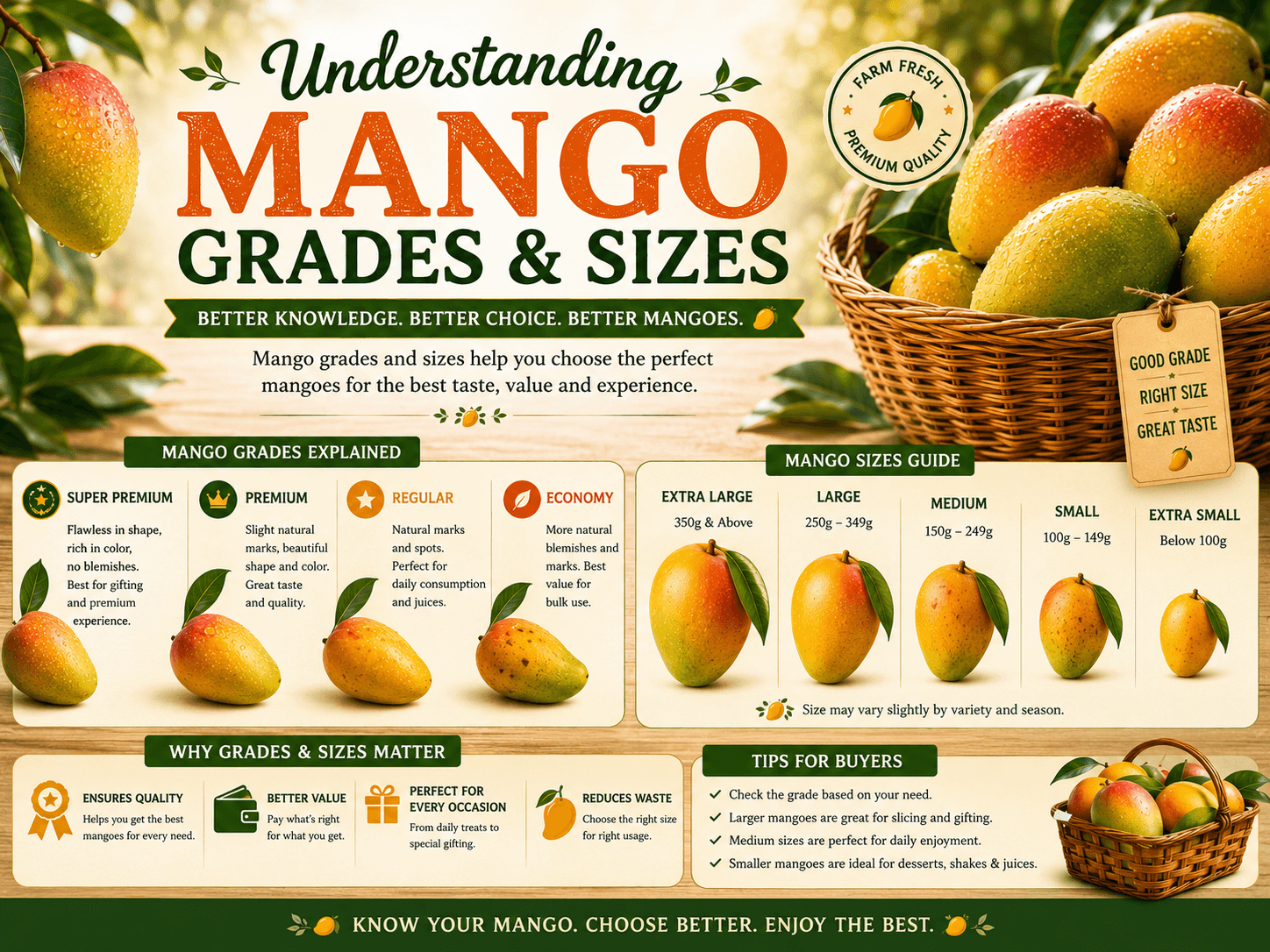
Whether you’re buying mangoes from a local market or ordering them online, you’ve probably come across terms like Grade A, premium quality, large size, or export grade. While these labels may seem confusing at first, understanding mango grades and sizes can help you make better purchasing decisions and choose fruit that matches your needs.
It’s important to remember that a larger mango isn’t always sweeter, and a smaller mango isn’t necessarily lower in quality. Mango grading considers several characteristics, including appearance, maturity, shape, size, and overall condition. These standards help growers, retailers, and consumers communicate quality expectations while ensuring consistency in the marketplace.
In this guide, we’ll explain how mango grades and sizes are determined, why they matter, and how to choose the right mangoes for your family, gifting, or special occasions.
What Are Mango Grades?
Mango grading is the process of sorting mangoes based on their overall quality and appearance after harvest.
Grading helps:
- Maintain consistent quality.
- Improve customer satisfaction.
- Simplify packaging.
- Support domestic and export markets.
- Reduce damage during transportation.
Each mango is carefully inspected before being packed.
What Factors Determine Mango Grades?
Growers and packing facilities typically evaluate several characteristics during grading.
These include:
- Size.
- Shape.
- Skin appearance.
- Color development.
- Maturity.
- Freshness.
- Freedom from defects.
- Overall presentation.
Only mangoes that meet quality standards are selected for premium packaging.
Understanding Mango Sizes
Mangoes naturally vary in size depending on the variety, growing conditions, and season.
They are commonly categorized as:
- Small.
- Medium.
- Large.
- Extra-large.
Different varieties naturally produce fruits of different sizes, so size alone does not determine quality.
Why Size Doesn’t Always Mean Better
Many people assume larger mangoes are sweeter or superior, but this is not always true.
The flavor of a mango depends more on:
- Variety.
- Natural ripening.
- Harvest maturity.
- Orchard management.
- Growing conditions.
Some smaller varieties, such as Himsagar, are widely appreciated for their rich sweetness despite their modest size.
Common Mango Grades
Although grading standards may vary among growers and markets, mangoes are often grouped into categories such as:
Premium Grade
Typically characterized by:
- Uniform size.
- Attractive appearance.
- Smooth skin.
- Excellent freshness.
- Minimal cosmetic blemishes.
These mangoes are commonly selected for gifting and premium retail.
Standard Grade
These mangoes usually offer:
- Good eating quality.
- Minor natural skin marks.
- Normal shape.
- Fresh pulp.
They are excellent for everyday household consumption.
Processing Grade
These mangoes may have:
- Cosmetic imperfections.
- Irregular shapes.
- Surface blemishes.
Although they may not look perfect, they are often suitable for:
- Juices.
- Smoothies.
- Ice cream.
- Pickles.
- Chutneys.
- Purees.
Appearance does not necessarily affect flavor.
How Mangoes Are Sorted After Harvest
Once harvested, mangoes are carefully handled to preserve quality.
The grading process generally includes:
- Cleaning.
- Visual inspection.
- Size sorting.
- Quality assessment.
- Packaging.
- Final inspection.
Careful handling helps minimize bruising and maintain freshness.
The Importance of Uniform Packaging
Packing mangoes of similar size offers several benefits.
It helps:
- Improve presentation.
- Protect fruit during transport.
- Promote even ripening.
- Make storage easier.
- Enhance customer satisfaction.
Uniform packaging is especially important for premium gift boxes.
Export-Quality Mangoes
Mangoes prepared for export often undergo additional quality checks.
These may include assessments of:
- Appearance.
- Maturity.
- Freshness.
- Cleanliness.
- Packaging quality.
Meeting export requirements helps ensure mangoes arrive in good condition after long-distance transportation.
Does Grade Affect Taste?
Not necessarily.
A mango’s taste depends primarily on:
- Variety.
- Ripeness.
- Growing conditions.
- Harvest timing.
- Natural ripening.
Even mangoes with small cosmetic blemishes can be exceptionally sweet and flavorful.
Choosing the Right Mango Size
Different sizes are suitable for different purposes.
Small to Medium Mangoes
Ideal for:
- Individual servings.
- Lunch boxes.
- Fresh snacking.
- Children’s portions.
Medium to Large Mangoes
Excellent for:
- Family meals.
- Fruit platters.
- Desserts.
- Smoothies.
Large Mangoes
Perfect for:
- Sharing.
- Gifting.
- Juices.
- Bulk recipes.
Why Orchard Management Matters More Than Size
Healthy orchards contribute to consistently high-quality mangoes through practices such as:
- Proper irrigation.
- Balanced nutrition.
- Pruning.
- Pest management.
- Timely harvesting.
These factors have a greater impact on flavor and quality than fruit size alone.
Premium Malda Mangoes
Malda in West Bengal is renowned for producing premium mangoes with exceptional quality and consistency.
Popular varieties include:
- Himsagar.
- Fazli.
- Lakshmanbhog.
- Gopalbhog.
- Khirsapati.
These mangoes are carefully harvested, naturally ripened, graded, and packed to preserve their flavor, freshness, and appearance.
Tips for Buying Quality Mangoes
When purchasing mangoes, consider:
- Buying from trusted growers.
- Choosing naturally ripened fruit.
- Looking for a pleasant aroma.
- Checking for slight softness.
- Selecting carefully packed boxes.
These simple steps can help you enjoy premium-quality mangoes throughout the season.
Final Thoughts
Understanding mango grades and sizes can make shopping much easier, whether you’re buying mangoes for your family, preparing desserts, or sending gift boxes. While grading helps classify mangoes based on appearance, size, and overall presentation, the true quality of a mango is determined by its variety, maturity, natural ripening, and careful orchard management.
Remember that a beautifully graded mango isn’t always the sweetest, and a fruit with a few natural skin marks can still offer outstanding flavor. By choosing naturally ripened mangoes from trusted growers, you can enjoy the best combination of freshness, sweetness, and quality every summer.
Choose Premium Graded Malda Mangoes with Confidence
Enjoy premium Malda Mangoes sourced directly from trusted orchards in West Bengal. Our Himsagar, Fazli, Lakshmanbhog, Gopalbhog, and Khirsapati mangoes are handpicked at peak maturity, naturally ripened, carefully graded, thoroughly quality-checked, and securely packed before being delivered fresh across India. Whether you’re ordering for your family, gifting loved ones, or preparing delicious recipes, our premium mangoes deliver exceptional quality and authentic flavor in every box.