

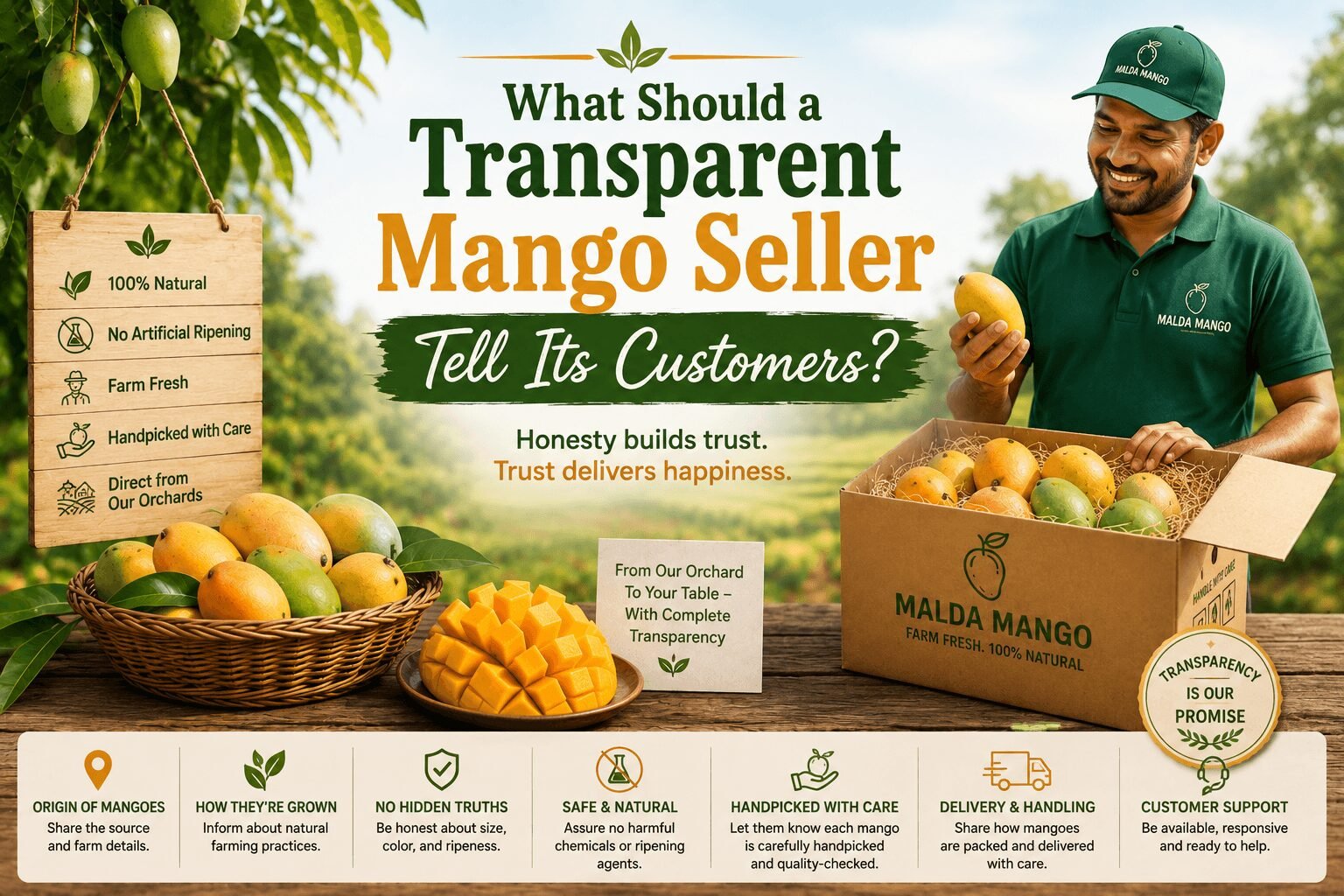
When buying fresh mangoes online, customers are not simply purchasing fruit. They are trusting a seller to provide accurate information about where the mangoes came from, which variety they are receiving, how the fruit was handled, and what to expect after delivery.
A transparent mango seller makes this information easy to understand.
Transparency does not mean revealing every detail of a business operation. It means giving customers clear, accurate, and useful information about the product and its journey from orchard to doorstep.
For regional mangoes such as Malda mangoes, this is especially important because variety, origin, harvest maturity, and natural ripening can all influence the final eating experience.
What Does Transparency Mean When Buying Mangoes?
A transparent mango seller should help customers understand:
- What variety they are buying.
- Where the mangoes were grown.
- How they were sourced.
- When and at what maturity stage they were harvested.
- How they were graded.
- How they are packed.
- How they are transported.
- How they should be ripened and stored.
- What customers should realistically expect.
The goal is simple: no unnecessary confusion and no misleading promises.
1. Clearly State the Mango Variety
The first thing a customer should know is what mango they are purchasing.
A seller should clearly identify the variety, such as:
- Himsagar.
- Fazli.
- Lakshmanbhog.
- Gopalbhog.
- Khirsapati.
- Alphonso.
- Kesar.
- Dasheri.
- Langra.
Each variety has different characteristics.
For example, customers may want to know whether a mango is:
- Fibre-light.
- Creamy.
- Highly aromatic.
- Large and pulp-rich.
- Naturally sweet.
- Suitable for specific recipes.
Clear variety information helps customers choose according to their preferences.
2. Tell Customers Where the Mangoes Come From
Origin is one of the most important pieces of information a mango seller can provide.
Instead of simply saying “Indian mangoes,” a transparent seller should provide a more specific growing region whenever possible.
For example:
Grown in Malda, West Bengal
is more informative than simply:
Product of India
This distinction matters because different regions are associated with different mango varieties and growing conditions.
3. Explain the Difference Between Growing Origin and Packing Location
Customers can easily misunderstand location information.
A mango may be:
Grown in Malda → Transported to a packing facility → Packed → Delivered
Therefore, a seller should make it clear whether a location refers to:
- Growing region.
- Collection center.
- Packing facility.
- Warehouse.
- Dispatch location.
This avoids creating a misleading impression about where the fruit was actually grown.
4. Explain How the Mangoes Are Sourced
Customers may want to know whether mangoes are sourced:
- Directly from farmers.
- From specific orchards.
- Through grower networks.
- From agricultural suppliers.
- Through local collection systems.
A seller should describe its sourcing model honestly.
For example, saying “sourced from partner orchards in Malda” is more transparent than making a vague claim such as “straight from the farmer” if multiple supply-chain partners are involved.
5. Explain Harvest Timing
Customers should understand that the harvest date and eating date are not necessarily the same.
Many mangoes continue to ripen after harvest.
A transparent seller can explain:
- When the mangoes are generally harvested.
- Their expected ripening stage.
- Whether they may arrive firm.
- How long they may take to become ready to eat.
This helps customers avoid confusing a firm, properly harvested mango with an inferior product.
6. Be Honest About Natural Ripening
If mangoes are naturally ripened, sellers should explain what that means.
Customers may want to know:
- Whether the mangoes continue ripening after delivery.
- How to identify ripeness.
- Where to keep them while they ripen.
- When refrigeration is appropriate.
Clear instructions can significantly improve the customer’s experience.
7. Don’t Promise Identical Color or Appearance
Mangoes are agricultural products, so natural variation is expected.
A transparent seller should explain that mangoes may differ slightly in:
- Skin color.
- Shape.
- Size.
- Surface appearance.
- Ripening speed.
For some varieties, a mango may remain green even when ripe.
Therefore, customers should not be encouraged to judge ripeness solely by skin color.
8. Explain Mango Quality Standards
A seller should explain what it means when it calls its mangoes:
- Premium.
- Grade A.
- Select.
- Farm fresh.
- Naturally ripened.
- Handpicked.
These terms can mean different things across businesses.
If a seller uses a quality grade, it should ideally explain what the grade represents.
For example, quality assessment may consider:
- Size.
- Maturity.
- Appearance.
- Firmness.
- Physical damage.
- Overall condition.
9. Be Honest About Cosmetic Imperfections
Perfect-looking mangoes are not always the only good mangoes.
Natural mangoes can have:
- Minor scars.
- Surface marks.
- Slight color variations.
- Small shape irregularities.
A transparent seller can explain that minor cosmetic imperfections may occur without significantly affecting the edible pulp.
At the same time, the seller should distinguish these from serious defects such as:
- Mold.
- Rot.
- Deep cuts.
- Significant bruising.
- Severe deterioration.
10. Tell Customers How Mangoes Are Packed
Packaging is an important part of the freshness journey.
Customers should ideally know that mangoes are packed to protect them from:
- Impact.
- Compression.
- Excessive movement.
- Rough handling.
A seller can also explain whether mangoes are individually protected, separated by layers, or packed using other protective methods.
11. Explain the Delivery Process
Delivery information should be clear before the customer places an order.
This may include:
- Shipping locations.
- Estimated delivery timelines.
- Delivery partners or methods.
- Dispatch schedules.
- Packaging practices.
Avoid promising an exact delivery time if circumstances such as weather, logistics, or regional delivery conditions can affect the shipment.
12. Explain How Mangoes May Arrive
A customer should know whether the mangoes are expected to arrive:
- Firm.
- Partially ripe.
- Ready to eat.
This is particularly important for fresh mangoes because ripening continues after harvest.
A mango arriving firm is not necessarily a problem if it was intentionally packed at a stage that allows it to ripen naturally at home.
13. Provide Clear Storage Instructions
A transparent seller should tell customers how to care for their mangoes after delivery.
Instructions can explain:
If mangoes are firm
Allow them to ripen under suitable room-temperature conditions according to the seller’s guidance.
Once ripe
Refrigeration can generally slow further ripening.
After cutting
Store cut mangoes properly in a clean, covered container and refrigerate them.
Clear instructions help customers protect the quality they received.
14. Explain How to Identify Ripeness
Customers should not have to guess when their mangoes are ready.
A seller can explain that ripeness may be assessed through:
- Gentle firmness.
- Fruity aroma.
- Texture.
- Overall condition.
Skin color should not be the only indicator because different varieties naturally look different.
15. Share Relevant Harvest and Batch Information
Where available, sellers can provide information such as:
- Harvest period.
- Packing date.
- Batch or lot number.
- Variety.
- Origin.
This supports traceability and gives customers greater confidence in the product.
However, businesses should only provide information they can substantiate.
16. Explain What “Farm Fresh” Actually Means
“Farm fresh” is commonly used in food marketing, but customers deserve clarity.
A transparent seller should explain its own definition.
For example, it could describe:
- Where fruit is sourced.
- How quickly it moves from harvest to packing.
- How it is handled.
- How it is delivered.
The phrase should communicate something meaningful rather than simply serve as a marketing label.
17. Be Clear About Pricing
Transparency should extend beyond the fruit itself.
Customers should understand the final price and any relevant charges.
Depending on the seller, this may include:
- Mango price.
- Quantity or weight.
- Packaging charges.
- Delivery charges.
- Applicable taxes.
Unexpected costs can create unnecessary frustration.
18. Explain Quantity and Weight Clearly
A customer ordering “one box” should know what that means.
A seller should specify:
- Net weight.
- Approximate number of mangoes, where relevant.
- Variety.
- Pack size.
The number of mangoes can naturally vary because fruit sizes differ, so weight-based information can be especially useful.
19. Explain Seasonal Availability
Mangoes are seasonal fruits.
A transparent seller should explain that availability can change depending on:
- Variety.
- Growing region.
- Weather.
- Harvest timing.
- Seasonal demand.
This helps customers understand why a particular mango may be available only during certain periods.
20. Don’t Make Unsupported Claims
Responsible communication means avoiding claims that cannot be verified.
Sellers should be careful with statements such as:
- “Guaranteed chemical-free.”
- “Always picked the same day.”
- “Zero pesticides.”
- “100% organic.”
- “Never treated.”
- “Guaranteed sweetest mango.”
If a claim is made, customers should be able to understand what it means and, where appropriate, what supports it.
21. Explain the Return or Replacement Policy
Fresh produce can sometimes experience issues during transportation.
A transparent seller should clearly communicate:
- What happens if fruit arrives damaged.
- Whether customers need photographs.
- How quickly an issue must be reported.
- Whether replacements or refunds are available.
- What conditions apply.
Clear policies reduce uncertainty when customers encounter a genuine delivery problem.
22. Make Customer Support Accessible
Transparency isn’t just about product information.
Customers should also have a way to ask questions about:
- Orders.
- Delivery.
- Ripening.
- Product condition.
- Replacement policies.
Good communication builds trust beyond the initial purchase.
What Information Should a Mango Product Page Include?
A well-designed mango product page can include:
| Information | Why Customers Need It |
|---|---|
| Variety | Understand expected taste and texture |
| Growing origin | Know where the fruit was grown |
| Weight | Understand the quantity purchased |
| Season | Know when the variety is available |
| Maturity | Understand expected condition on arrival |
| Ripening guidance | Know how to prepare the fruit |
| Packaging | Understand how it is protected |
| Delivery | Know when to expect the order |
| Quality information | Understand grading and inspection |
| Returns/replacements | Know what happens if there is a problem |
Why Transparency Matters for Malda Mangoes
Malda is known for its mango-growing heritage and varieties such as:
- Himsagar.
- Fazli.
- Lakshmanbhog.
- Gopalbhog.
- Khirsapati.
When customers purchase a mango marketed as a Malda variety, they may reasonably want to know more than just the name.
A transparent seller should explain the variety, growing region, sourcing approach, expected characteristics, maturity, handling, and delivery process.
This makes it easier for customers to understand what they are actually purchasing.
A Simple Transparency Checklist for Mango Sellers
Before buying, customers can ask:
1. What variety is this?
2. Where was it grown?
3. How was it sourced?
4. When is it harvested?
5. Will it arrive firm or ready to eat?
6. How should I ripen it?
7. How is it packed?
8. How long does delivery usually take?
9. What quality checks are performed?
10. What happens if the fruit arrives damaged?
A seller that provides clear answers to these questions makes the buying experience much more transparent.
What Transparency Does Not Mean
Transparency does not mean promising perfection.
Natural mangoes can vary in:
- Size.
- Shape.
- Color.
- Ripening speed.
- Surface appearance.
A responsible seller should communicate these natural variations instead of making unrealistic promises.
Being transparent means setting accurate expectations, not claiming that every box will look identical.
Final Thoughts
A transparent mango seller should give customers enough information to make an informed decision before placing an order.
That includes details about variety, origin, sourcing, harvest maturity, grading, packaging, ripening, storage, pricing, delivery, and replacement policies.
For regional mangoes such as Malda mangoes, transparency becomes even more valuable because the growing region and variety are an important part of the product’s identity.
The best mango-selling experience is not built on exaggerated promises. It is built on accurate information, careful quality management, clear communication, and realistic expectations.
When customers know what they are buying and what to expect when it arrives, trust becomes a natural part of the farm-to-consumer journey.
Experience Premium Malda Mangoes
Experience the authentic taste of premium Malda Mangoes sourced from trusted orchards in West Bengal. Our Himsagar, Fazli, Lakshmanbhog, Gopalbhog, and Khirsapati mangoes are carefully sourced, harvested at the appropriate maturity stage, naturally ripened, sorted, graded, quality-checked, and securely packed before delivery across India. We provide clear information about variety, origin, quality, ripening, and handling so you know what to expect from orchard to doorstep while enjoying the naturally sweet flavor, rich aroma, smooth texture, and premium quality of authentic Malda mangoes.