

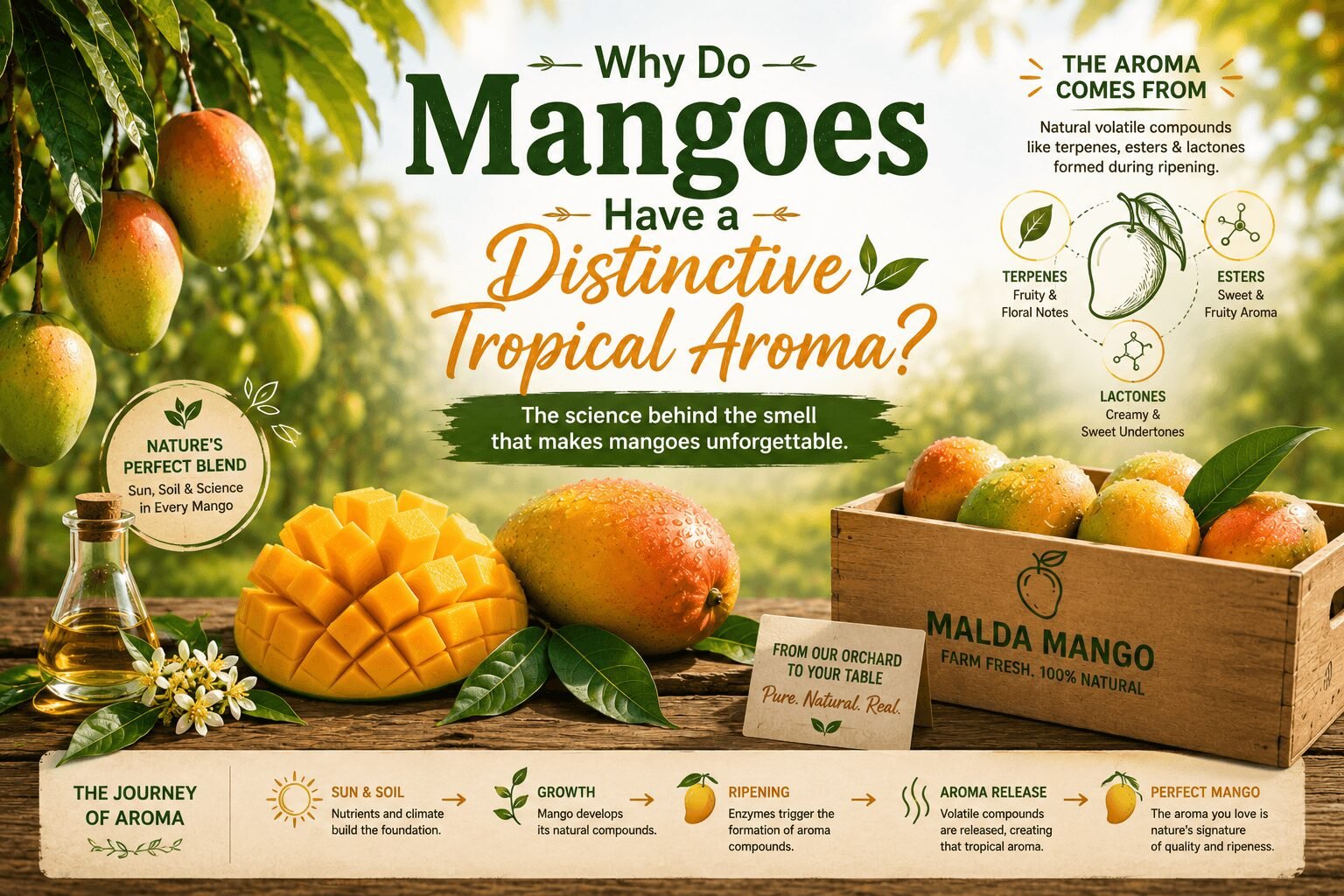
One of the first things people notice about a ripe mango is often its aroma.
Before you even cut it open, a ripe mango can fill the room with a sweet, fruity, floral, and distinctly tropical fragrance. This characteristic smell is one of the reasons mangoes are so recognizable and enjoyable.
But where does that aroma actually come from?
The answer lies in the natural volatile compounds produced by the mango as it grows and ripens. These compounds interact to create the complex fragrance associated with different mango varieties.
From the orchard to your kitchen, several factors influence how a mango smells, including its variety, maturity, growing conditions, and post-harvest handling.
What Creates the Aroma of a Mango?
Mango aroma is produced by a mixture of naturally occurring volatile organic compounds, often called volatile aroma compounds.
These compounds can include different groups such as:
- Esters.
- Terpenes.
- Lactones.
- Aldehydes.
- Alcohols.
- Other volatile compounds.
The exact combination and concentration vary between mango varieties.
That is why one mango may smell strongly floral while another may have a sweeter, citrus-like, fruity, or resinous aroma.
Why Does Mango Aroma Become Stronger as It Ripens?
A mango’s aroma generally becomes more noticeable as it approaches eating ripeness.
During ripening, the fruit undergoes several biochemical changes.
These include changes in:
- Sugars.
- Acids.
- Pigments.
- Cell structure.
- Volatile compounds.
As aroma compounds are produced or released in greater quantities, the characteristic fragrance of the mango becomes easier to detect.
This is why an unripe mango may have a relatively mild or green smell, while a ripe mango can have a much stronger fruity aroma.
1. Variety Has a Major Influence on Aroma
Not all mangoes smell the same.
Different varieties have different genetic characteristics that influence their aroma compounds.
For example, mango varieties may produce aromas described as:
- Floral.
- Sweet.
- Fruity.
- Citrus-like.
- Pine-like.
- Resinous.
- Tropical.
- Spicy.
This natural diversity is part of what makes exploring different mango varieties interesting.
2. Himsagar and Its Aromatic Character
Himsagar is a well-known mango variety associated with West Bengal.
It is appreciated for its:
- Sweet aroma.
- Smooth pulp.
- Rich flavor.
- Low-fibre eating experience.
When properly ripe, its fragrance can become noticeably more pronounced, adding to the sensory experience before the fruit is even cut.
3. Fazli and Its Distinctive Profile
Fazli mangoes are known for their large size and substantial pulp.
Their aroma can be influenced by the fruit’s maturity and growing conditions, with ripe fruit developing a characteristic fruity fragrance.
Because aroma compounds vary between varieties, Fazli does not necessarily smell exactly like Himsagar or other mangoes.
4. Aroma and Flavor Are Not the Same Thing
It’s easy to think that aroma and taste are identical, but they are different parts of the eating experience.
Taste primarily involves sensations such as:
- Sweet.
- Sour.
- Bitter.
- Salty.
- Umami.
Aroma involves volatile compounds detected by the olfactory system.
When you eat a mango, aroma compounds travel from the mouth toward the nose through the back of the throat. This is called retronasal olfaction.
That is one reason mango flavor seems much more complex than sweetness alone.
5. Why a Mango Can Smell Sweet
A mango doesn’t necessarily contain a single “sweet smell” compound.
Instead, multiple volatile compounds interact to create an overall sensory impression.
Some compounds contribute fruity or floral notes, while others may add citrus-like, resinous, or tropical characteristics.
Together, they create the aroma that people recognize as a ripe mango.
6. Terpenes Contribute to Mango Aroma
Terpenes are an important class of natural compounds found in many plants and fruits.
In mangoes, compounds such as monoterpenes and sesquiterpenes can contribute to the characteristic aroma.
Different concentrations of these compounds can create noticeably different fragrance profiles between varieties.
This is one reason mango aroma can be complex rather than simply “sweet.”
7. Esters Can Add Fruity Notes
Esters are another group of volatile compounds commonly associated with fruity aromas.
Depending on the specific compounds present, they can contribute impressions such as:
- Fruity.
- Sweet.
- Tropical.
- Floral.
The combination of esters with other aroma compounds helps create the overall fragrance of ripe mangoes.
8. Lactones Can Contribute Creamy or Fruity Notes
Some mango varieties contain lactones that can contribute distinctive fruity or creamy sensory notes.
These compounds are also found in other fruits and foods and can contribute to the perception of richness in aroma.
The exact aroma profile depends on the variety and the relative concentration of different compounds.
9. Ripeness Changes the Aroma Profile
Mango aroma is not static.
As the fruit ripens:
Unripe → Developing aroma → Ripe → Overripe
The types and concentrations of volatile compounds can change throughout this process.
At the ideal eating stage, the aroma is often strong and pleasant.
If a mango becomes excessively overripe, its aroma can change and may become fermented or unpleasant.
10. Growing Conditions Can Influence Aroma
A mango’s aroma begins developing in the orchard.
Factors such as:
- Temperature.
- Rainfall.
- Sunlight.
- Soil conditions.
- Water availability.
- Orchard environment.
can influence fruit development and potentially affect its final aroma profile.
However, variety and maturity remain important factors in determining the sensory characteristics of the fruit.
11. Climate and Mango Aroma
Mangoes thrive in warm growing environments.
Temperature influences the plant’s growth, flowering, fruit development, and ripening processes.
Different growing regions can therefore produce mangoes with somewhat different sensory profiles, even when the same variety is grown.
This contributes to the regional character associated with many traditional mango-growing areas.
12. Why Mango Aroma Can Be Stronger at Room Temperature
You may notice that a mango smells much stronger after sitting at room temperature than when it is chilled.
Temperature affects the volatility of aroma compounds.
When fruit is warmer, volatile molecules can move into the air more readily, making the aroma easier for your nose to detect.
This is one reason chilled mangoes may initially seem less aromatic.
13. Does Refrigeration Change Mango Aroma?
Refrigeration can affect the way mango aroma is perceived.
Cold temperatures generally reduce the volatility of many aroma compounds, making them less noticeable.
Long or inappropriate storage conditions can also affect fruit quality and the development or retention of volatile compounds.
For this reason, mangoes are often best evaluated for aroma when they are at a suitable serving temperature.
14. Why Cutting a Mango Releases More Aroma
A whole mango has a relatively limited exposed surface area.
Once you cut it, you expose:
- Pulp.
- Juice.
- Internal tissues.
This allows volatile compounds to escape more readily.
That is why cutting into a ripe mango can suddenly release a much stronger fragrance.
15. Why Some Mangoes Smell Stronger Than Others
Several factors can explain differences in aroma intensity.
Variety
Genetics influence which volatile compounds are produced.
Ripeness
Ripe mangoes generally release more noticeable aroma compounds than unripe fruit.
Growing Conditions
Climate and orchard conditions influence fruit development.
Storage
Post-harvest conditions can affect aroma development and retention.
Temperature
Warmer fruit generally releases volatile compounds more readily.
Individual Sensitivity
People also perceive aromas differently. What smells extremely strong to one person may seem mild to another.
How to Tell if a Mango Is Aromatic and Ready to Eat
Aroma can be one useful indicator of ripeness, but it should not be used alone.
Look for a combination of:
- Pleasant fruity aroma.
- Appropriate firmness.
- Variety-specific appearance.
- Natural ripening characteristics.
- Overall fruit condition.
Some varieties can remain relatively green even when ripe, so skin color is not always a reliable indicator.
Mango Aroma vs. Artificial Fragrance
A naturally aromatic mango develops its fragrance through biological processes during fruit development and ripening.
Artificial mango fragrance, on the other hand, is created using selected aroma chemicals or extracts.
The complexity of natural mango aroma comes from the interaction of many compounds rather than a single ingredient.
This is why reproducing the exact aroma of a particular mango variety can be difficult.
Why Malda Mangoes Have Their Own Aroma Profiles
Malda in West Bengal has a long mango-growing tradition and is associated with several varieties, including:
- Himsagar.
- Fazli.
- Lakshmanbhog.
- Gopalbhog.
- Khirsapati.
Each variety has its own combination of genetic characteristics and aroma compounds.
This means that “Malda mango aroma” isn’t necessarily one single smell.
Instead, the region offers a range of aroma profiles depending on the variety, maturity, and growing conditions.
How Aroma Helps You Enjoy Mangoes
Mango aroma plays an important role in the overall eating experience.
Before tasting the fruit, your sense of smell can already provide information about:
- Ripeness.
- Variety characteristics.
- Freshness.
- Fruit condition.
When aroma combines with sweetness, acidity, texture, and mouthfeel, it creates the complete sensory experience we think of as mango flavor.
Mango Aroma: From Orchard to Table
The development of mango aroma can be viewed as a journey:
Growing → Maturing → Harvesting → Ripening → Aroma Development → Eating
At each stage, biological and environmental factors can influence the final sensory characteristics.
This is why a mango’s aroma isn’t simply created at the moment you cut it open. It is the result of processes that begin while the fruit is developing on the tree.
Common Questions About Mango Aroma
Does a stronger mango smell always mean better quality?
Not necessarily. Aroma intensity is influenced by variety, ripeness, temperature, and other factors. A strong smell does not automatically guarantee superior eating quality.
Why does my mango smell sour or fermented?
An unusual fermented or alcoholic smell can indicate that the fruit has become excessively ripe or has begun deteriorating. Check the fruit’s texture and appearance before consuming it.
Can an unripe mango have an aroma?
Yes. Unripe mangoes can have green, grassy, resinous, or acidic aromas. Their aroma profile changes as ripening progresses.
Why do different mango varieties smell different?
Genetic differences cause varieties to produce different combinations and concentrations of volatile aroma compounds.
Final Thoughts
The distinctive tropical aroma of mangoes comes from a complex mixture of naturally occurring volatile compounds that develop and change as the fruit matures and ripens.
Variety, growing conditions, maturity, storage, and temperature can all influence how a mango smells.
This complexity is one of the reasons mangoes are so fascinating. A Himsagar from West Bengal may have a noticeably different aromatic character from an Alphonso, Kesar, Fazli, or another variety.
So the next time you bring a ripe mango home, take a moment before cutting it. That unmistakable tropical fragrance is more than just a pleasant smell—it’s the result of variety, biology, ripening, and the fruit’s journey from tree to table.
Experience Premium Malda Mangoes
Experience the naturally rich aroma and flavor of premium Malda Mangoes sourced from trusted orchards in West Bengal. Our Himsagar, Fazli, Lakshmanbhog, Gopalbhog, and Khirsapati mangoes are carefully sourced, harvested at the appropriate maturity stage, naturally ripened, sorted, quality-checked, and securely packed before delivery across India. Each variety offers its own distinctive aroma, sweetness, texture, and flavor profile, allowing you to experience the natural diversity of authentic Malda mangoes.