

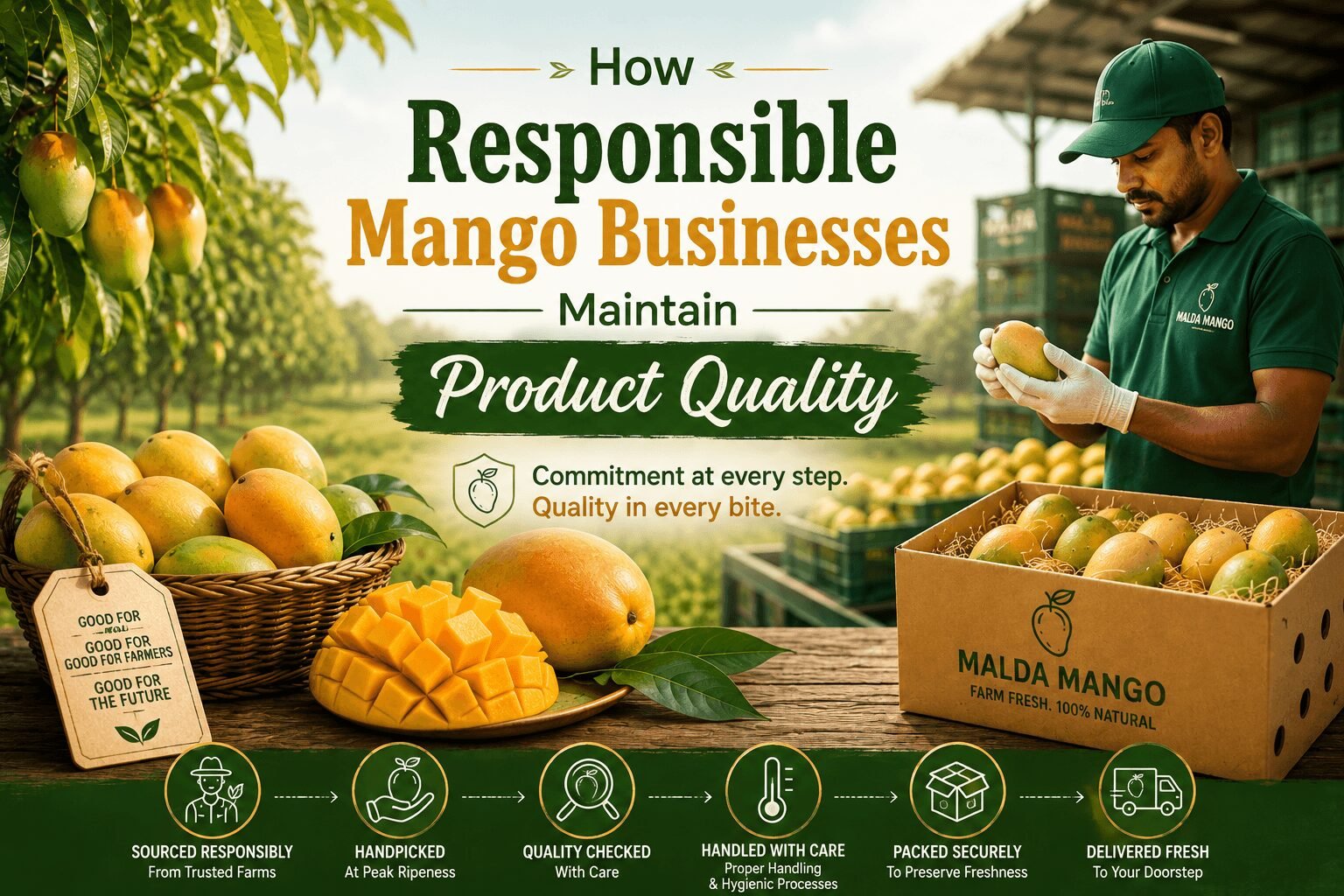
Producing high-quality mangoes is only the beginning. Maintaining that quality from the orchard to the customer’s home requires careful planning at every stage of the supply chain.
Responsible mango businesses understand that fruit quality can change after harvest. Handling, temperature, packaging, transportation, ripening, and storage can all influence the condition of mangoes by the time they reach consumers.
That is why a reliable mango business needs more than good fruit. It needs a well-managed quality process that protects the fruit throughout its journey.
From sourcing mangoes from suitable orchards to carefully inspecting, grading, packing, and delivering them, every step contributes to the final customer experience.
What Does Product Quality Mean for Mangoes?
Mango quality involves much more than appearance.
A quality-focused business may consider:
- Variety.
- Origin.
- Harvest maturity.
- Size and weight.
- Firmness.
- Aroma.
- Skin condition.
- Pulp quality.
- Defects.
- Packaging.
- Handling.
- Storage.
- Transportation.
- Customer feedback.
The exact standards can vary depending on the mango variety and target market.
1. Responsible Sourcing Starts at the Farm
Quality begins with sourcing.
Responsible businesses carefully select growers and orchards based on factors such as:
- Growing region.
- Mango varieties.
- Orchard practices.
- Harvesting methods.
- Fruit quality.
- Seasonal availability.
- Supply consistency.
Building strong relationships with growers can also help businesses better understand where their mangoes come from.
2. Selecting the Right Mango Varieties
Different mango varieties naturally have different characteristics.
For example:
- Himsagar is known for its smooth pulp and rich flavor.
- Fazli is recognized for its large size and generous pulp.
- Lakshmanbhog is appreciated for its distinctive sweetness and aroma.
- Gopalbhog is valued for its rich flavor and seasonal appeal.
- Khirsapati is known for its sweet, aromatic pulp.
Responsible sellers understand these differences rather than treating every mango as though it has the same quality characteristics.
3. Harvesting at the Appropriate Maturity
Harvest timing can have a significant influence on mango quality.
Mangoes harvested too early may not develop their expected eating characteristics properly, while fruit harvested too late may have a shorter window for transportation and consumption.
Responsible businesses work with growers to select fruit at an appropriate maturity stage for the intended supply chain.
4. Careful Harvesting Reduces Damage
Mangoes can be damaged during harvesting if they are dropped, squeezed, or handled roughly.
Responsible harvesting practices aim to minimize:
- Cuts.
- Bruises.
- Punctures.
- Compression.
- Stem damage.
Careful handling at this stage helps protect the fruit before it even reaches the packing process.
5. Sorting and Inspection
After harvesting, mangoes can be inspected and sorted.
This process may identify fruit with:
- Severe bruising.
- Deep cuts.
- Rot.
- Mold.
- Significant pest damage.
- Excessive softness.
- Other quality concerns.
The objective is not necessarily to make every mango visually perfect. It is to ensure that fruit meets the appropriate quality standards for its intended market.
6. Understanding Cosmetic Imperfections
Responsible businesses also understand that natural fruit can have minor visual imperfections.
Small:
- Scars.
- Surface marks.
- Color variations.
- Shape differences.
do not automatically mean a mango has poor eating quality.
A sensible quality-control process distinguishes between cosmetic imperfections and defects that affect the fruit itself.
This can also help reduce unnecessary food waste.
7. Grading Mangoes Consistently
Grading helps create more consistent batches.
Depending on the business and market, mangoes may be grouped according to:
- Variety.
- Size.
- Weight.
- Maturity.
- Appearance.
- Overall condition.
Consistent grading helps customers know what to expect when they place an order.
8. Monitoring Ripeness
Mangoes continue to change after harvest.
Responsible businesses consider the ripening stage when preparing fruit for delivery.
Depending on the variety and destination, mangoes may be shipped at a stage that allows them to continue ripening during transportation.
Businesses may monitor:
- Firmness.
- Aroma.
- Color.
- Maturity.
- Expected delivery time.
This helps reduce the risk of fruit arriving either excessively unripe or overripe.
9. Using Suitable Packaging
Packaging is an important part of quality management.
Mangoes need protection from:
- Impact.
- Compression.
- Excessive movement.
- Rough handling.
- Environmental exposure.
Good packaging should balance protection with appropriate ventilation and space for the fruit.
Poor packaging can result in bruising even when the mangoes were excellent at the time of packing.
10. Managing Transportation Carefully
The journey from orchard to customer can involve multiple stages.
Responsible businesses pay attention to:
- Loading.
- Unloading.
- Transit time.
- Handling.
- Packaging stability.
- Storage conditions.
Reducing unnecessary handling can help minimize physical damage.
11. Maintaining Appropriate Storage Conditions
Storage conditions can affect how quickly mangoes ripen and how long they maintain good quality.
Businesses consider factors such as:
- Temperature.
- Humidity.
- Ventilation.
- Storage duration.
- Fruit maturity.
The appropriate conditions depend on the mango variety and stage of ripeness.
12. Maintaining Traceability
Traceability helps businesses understand where their mangoes came from and how they moved through the supply chain.
Records may include:
- Orchard or grower.
- Variety.
- Harvest date.
- Batch number.
- Packing date.
- Distribution details.
If a quality issue occurs, traceability can help identify the relevant batch and investigate the cause.
13. Keeping Accurate Orchard and Harvest Records
Detailed records can provide valuable information over multiple seasons.
Businesses and growers may track:
- Harvest timing.
- Variety performance.
- Fruit quality.
- Orchard conditions.
- Seasonal patterns.
- Quality issues.
This information can help identify recurring problems and improve future sourcing decisions.
14. Quality Checks Before Dispatch
A final inspection before shipment can help identify problems before mangoes reach customers.
A dispatch check may consider:
- Fruit condition.
- Firmness.
- Visible defects.
- Packaging.
- Quantity.
- Variety.
- Order accuracy.
This additional checkpoint can reduce avoidable delivery issues.
15. Providing Clear Ripening Instructions
Mangoes may arrive at different stages depending on their variety and supply journey.
Responsible sellers can provide customers with clear instructions about:
- How to ripen mangoes.
- Where to keep them.
- When to refrigerate them.
- How to identify eating maturity.
- How to store cut mangoes.
Good guidance can help customers get the best experience from the fruit.
16. Managing Customer Feedback
Quality management should continue after delivery.
Customer feedback can reveal issues that may not be obvious during packing.
Businesses can monitor feedback about:
- Ripeness.
- Packaging.
- Fruit condition.
- Delivery.
- Flavor.
- Quantity.
- Overall experience.
Patterns in customer feedback can help identify areas that need improvement.
17. Reducing Unnecessary Food Waste
Responsible businesses recognize that not every mango needs to look perfectly uniform to be enjoyable.
Separating truly damaged fruit from harmless cosmetic imperfections can help reduce unnecessary waste.
For example, a mango with a minor natural scar may still have excellent pulp.
This approach supports both quality management and more responsible use of agricultural produce.
18. Maintaining Communication With Customers
Clear communication can make a major difference.
Customers should ideally receive useful information about:
- What variety they are receiving.
- Where it was sourced.
- Expected ripeness.
- Delivery timing.
- Storage.
- Ripening.
Transparency helps set realistic expectations and builds trust.
19. Quality Is About More Than Freshness
Freshness is important, but mango quality involves several factors.
A good mango should be evaluated according to:
Variety + Maturity + Condition + Handling + Storage + Delivery
A fruit can be recently harvested but poorly handled. Similarly, a mango can have a minor cosmetic mark while still offering excellent eating quality.
Responsible businesses therefore look at the complete quality picture.
How Responsible Mango Businesses Protect Quality
A simplified quality-control journey looks like this:
1. Source
Select suitable growers and orchards.
2. Harvest
Pick fruit at an appropriate maturity stage.
3. Inspect
Check fruit for major defects and damage.
4. Grade
Sort according to appropriate standards.
5. Pack
Protect mangoes from physical damage.
6. Store
Maintain suitable conditions.
7. Transport
Minimize unnecessary handling.
8. Inspect Again
Check orders before dispatch.
9. Deliver
Get the fruit to customers through a reliable delivery process.
10. Learn
Use customer feedback to improve future batches.
Quality Management for Malda Mangoes
Malda, West Bengal, is widely known for its mango-growing heritage and diverse varieties.
Popular varieties associated with the region include:
- Himsagar.
- Fazli.
- Lakshmanbhog.
- Gopalbhog.
- Khirsapati.
Responsible businesses sourcing Malda mangoes need to consider the natural characteristics of each variety.
For example, the expected appearance, texture, aroma, size, and ripening behavior of Himsagar may differ from Fazli. Applying the same standards to every variety could result in inaccurate quality assessments.
Proper variety identification, careful sourcing, appropriate maturity, grading, and handling therefore play an important role in maintaining the quality of Malda mangoes.
A Simple Quality Checklist for Mango Businesses
| Quality Stage | What Responsible Businesses Check |
|---|---|
| Sourcing | Grower, orchard, region, and variety |
| Harvest | Appropriate maturity |
| Handling | Minimal bruising and physical damage |
| Sorting | Major defects and deterioration |
| Grading | Size, weight, variety, and condition |
| Ripening | Appropriate stage for delivery |
| Packaging | Protection and ventilation |
| Storage | Suitable conditions |
| Transportation | Handling and transit |
| Dispatch | Final quality inspection |
| Delivery | Customer experience |
| Feedback | Issues and improvement opportunities |
Common Mistakes That Can Reduce Mango Quality
Harvesting Too Early
Fruit may not develop its expected eating characteristics properly.
Rough Handling
Drops and compression can create bruises.
Poor Packaging
Insufficient protection can result in damage during transportation.
Mixing Different Ripeness Stages
This can create inconsistent customer experiences.
Ignoring Variety Differences
Different mango varieties naturally have different characteristics.
Storing Fruit Incorrectly
Unsuitable conditions can accelerate deterioration or interfere with proper ripening.
Skipping Final Inspection
Problems can sometimes develop between packing and dispatch.
Why Responsible Practices Benefit Customers
When quality is managed throughout the supply chain, customers are more likely to receive mangoes that:
- Match the ordered variety.
- Arrive in suitable condition.
- Have appropriate ripeness.
- Are properly packed.
- Have fewer avoidable defects.
- Come with useful storage information.
This creates a more predictable and transparent buying experience.
Final Thoughts
Maintaining mango quality is a responsibility that begins before harvest and continues until the fruit reaches the customer.
Responsible mango businesses focus on careful sourcing, appropriate harvesting, gentle handling, sorting, grading, packaging, storage, transportation, traceability, and customer feedback.
The goal isn’t simply to sell attractive mangoes. It is to protect the natural quality of the fruit throughout its journey.
For premium regional mangoes such as those from Malda, this attention to detail can help preserve the qualities that make each variety special—from its natural sweetness and aroma to its characteristic pulp texture.
Ultimately, responsible mango businesses understand that quality is not created at the delivery stage; it is protected at every stage from orchard to consumer.
Experience Premium Malda Mangoes
Experience the authentic taste of premium Malda Mangoes sourced from trusted orchards in West Bengal. Our Himsagar, Fazli, Lakshmanbhog, Gopalbhog, and Khirsapati mangoes are carefully sourced, harvested at the appropriate maturity stage, naturally ripened, sorted, graded, quality-checked, and securely packed before delivery across India. From orchard selection to final dispatch, every stage is handled with care to preserve the naturally sweet flavor, rich aroma, smooth texture, freshness, and premium quality of authentic Malda mangoes.