

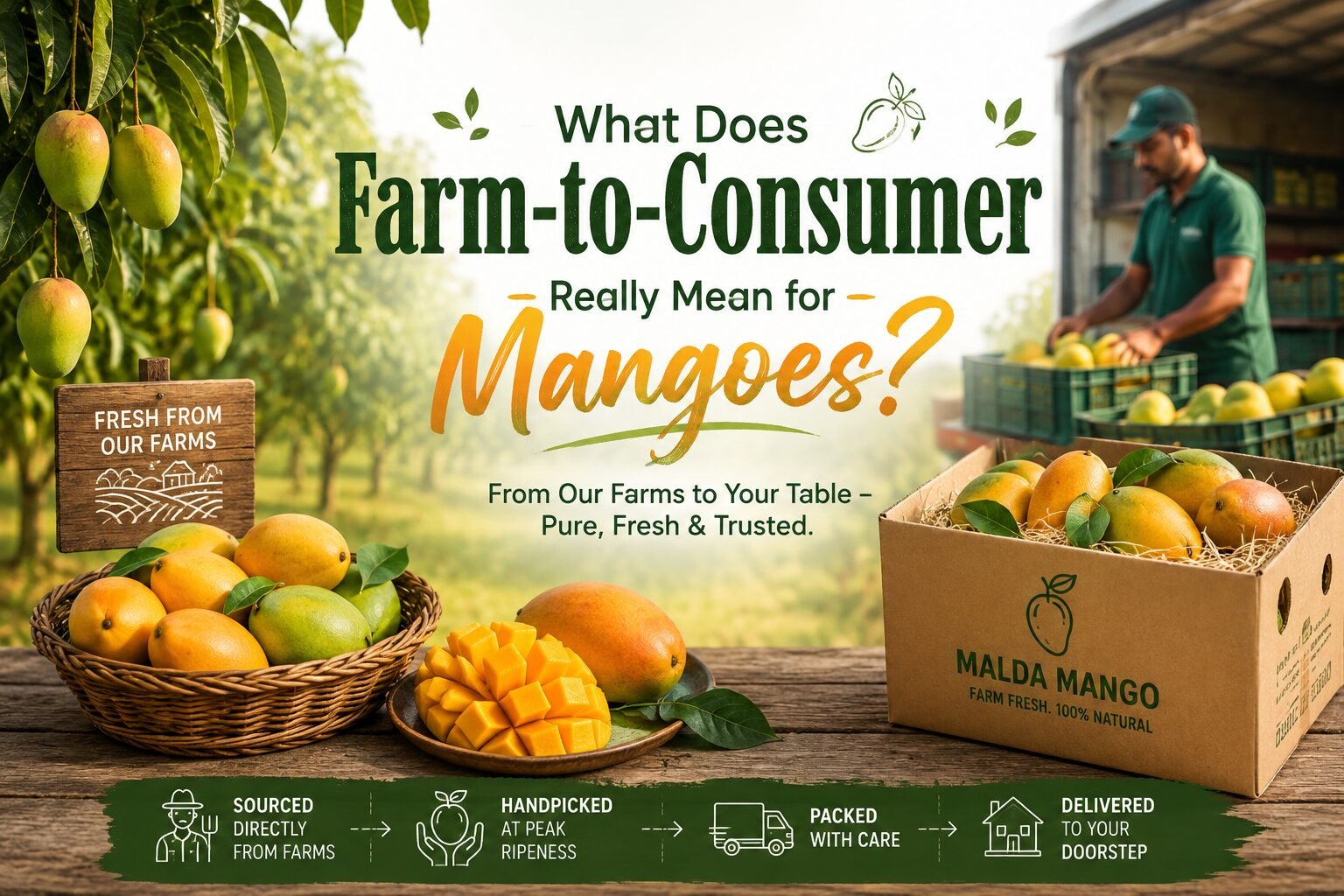
You may have seen the term farm-to-consumer used when buying fresh mangoes, but what does it actually mean?
In simple terms, farm-to-consumer describes a supply model where fresh produce moves from growers toward the final customer through a relatively direct and transparent supply chain. Instead of passing through numerous intermediaries, the fruit may travel through fewer stages before reaching the buyer.
For mangoes, this can provide greater visibility into where the fruit was grown, how it was harvested, how it was handled, and how it reached your doorstep.
However, “farm-to-consumer” does not always mean that a farmer personally packs and delivers every mango. The exact supply chain can vary between sellers.
What Does Farm-to-Consumer Mean?
A typical traditional mango supply chain may look something like:
Farmer → Local Trader → Wholesaler → Distributor → Retailer → Consumer
A farm-to-consumer model may be shorter:
Farmer/Orchard → Supplier → Consumer
Or, in some cases:
Farmer → Farm Collection → Packing → Delivery → Consumer
The number of stages depends on the business and its sourcing model.
The key idea is to create a more direct connection between the producer and the final buyer.
Why Is Farm-to-Consumer Mango Buying Becoming Popular?
Consumers increasingly want to know more about where their food comes from.
With farm-to-consumer mangoes, buyers may be able to learn more about:
- Growing region.
- Mango variety.
- Harvest timing.
- Sourcing practices.
- Packing.
- Handling.
- Delivery.
This can make the purchasing experience more transparent.
1. It Starts at the Orchard
The journey begins where the mangoes are grown.
The orchard is responsible for producing fruit through practices involving:
- Tree care.
- Water management.
- Soil management.
- Pest monitoring.
- Flowering management.
- Harvest preparation.
Growing conditions can influence the size, flavor, aroma, and overall characteristics of mangoes.
2. Choosing the Right Mango Variety
Farm-to-consumer sourcing can also make it easier to identify specific mango varieties.
Depending on the region, customers may find varieties such as:
- Himsagar.
- Fazli.
- Lakshmanbhog.
- Gopalbhog.
- Khirsapati.
- Alphonso.
- Kesar.
- Dasheri.
- Langra.
Each variety has its own characteristics, including texture, aroma, sweetness, fibre content, and ripening behavior.
3. Harvesting at the Appropriate Stage
Harvesting is an important part of the mango journey.
Mangoes are generally harvested when they have reached an appropriate stage of maturity for their intended market and journey.
Harvest timing can influence:
- Ripening.
- Flavor development.
- Texture.
- Shelf life.
- Transportation performance.
In a well-managed supply chain, harvesting is planned according to the variety and destination.
4. What Happens After Harvest?
The farm-to-consumer journey doesn’t end when the mango is picked.
After harvesting, mangoes may go through:
Collection → Sorting → Grading → Packing → Transportation → Delivery
Each step can influence the final condition of the fruit.
Careful handling helps reduce bruising, cuts, compression, and other physical damage.
5. Sorting and Grading
Mangoes can vary naturally in size, shape, appearance, and maturity.
Sorting helps separate fruit according to its condition.
Grading may consider factors such as:
- Size.
- Weight.
- Appearance.
- Maturity.
- Variety.
- Physical defects.
This helps suppliers create more consistent batches for customers.
6. Packaging for the Journey
Mangoes need suitable packaging when they are transported from orchards to consumers.
Good packaging can help protect the fruit from:
- Impact.
- Compression.
- Excessive movement.
- Rough handling.
- Environmental exposure.
The goal is to preserve the condition of the fruit throughout transportation.
7. Transportation From Farm to Home
One of the biggest differences in a farm-to-consumer model can be the number of distribution stages.
A shorter supply chain may reduce the number of times mangoes need to be:
- Loaded.
- Unloaded.
- Repacked.
- Moved between facilities.
Fewer handling stages can help reduce opportunities for physical damage, although the actual quality depends on how well the entire supply chain is managed.
Does Farm-to-Consumer Always Mean Faster Delivery?
Not necessarily.
A shorter supply chain can potentially simplify logistics, but delivery speed depends on:
- Location.
- Transportation method.
- Order volume.
- Packing schedule.
- Destination.
- Delivery network.
Therefore, farm-to-consumer should not automatically be interpreted as “same-day” or “next-day” delivery.
8. Better Understanding of Mango Origin
One advantage of a transparent farm-to-consumer model is that customers may receive more information about the origin of their fruit.
For example, a seller may identify:
Variety: Himsagar
Growing Region: Malda, West Bengal
Harvest: Seasonal
Packing: Recorded by batch
Delivery: Shipped to the customer
This information helps buyers understand the journey of their mangoes.
9. Farm-to-Consumer vs. Farm-to-Table
The two terms are related but not identical.
Farm-to-consumer generally describes the movement of agricultural products from growers toward individual customers.
Farm-to-table is often used more broadly to describe food sourced from farms for consumption, including restaurants, food businesses, and households.
For online mango purchases, farm-to-consumer is particularly relevant because the final destination is usually the individual buyer.
10. Does Farm-to-Consumer Mean There Are No Middlemen?
Not always.
A farm-to-consumer business may still work with:
- Packing partners.
- Logistics providers.
- Collection centers.
- Technology platforms.
- Quality-control teams.
- Delivery companies.
What matters is how the supply chain is structured and how transparently the seller communicates it.
The term should not be interpreted as a guarantee that absolutely no intermediary is involved.
11. Why Transparency Matters
Consumers increasingly want to understand the journey of their food.
A transparent mango supplier may provide information about:
- Origin.
- Variety.
- Harvest.
- Quality checks.
- Packing.
- Storage.
- Delivery.
This can help customers make more informed purchasing decisions.
12. Farm-to-Consumer Can Support Growers
When businesses establish stronger connections with growers, farmers may gain access to more organized demand.
Depending on the model, direct sourcing can help create opportunities for:
- Better market connections.
- More predictable demand.
- Greater visibility.
- Stronger relationships with buyers.
The actual benefit to farmers depends on the commercial arrangement and how value is distributed across the supply chain.
13. What About Mango Quality?
Farm-to-consumer sourcing does not automatically guarantee better mangoes.
Quality still depends on:
- Variety.
- Orchard practices.
- Harvest maturity.
- Handling.
- Sorting.
- Grading.
- Packaging.
- Storage.
- Transportation.
The advantage of a transparent supply chain is that it can make these stages easier to understand and manage.
14. Farm-to-Consumer and Natural Ripening
Mangoes often continue to ripen after harvest.
When mangoes are delivered to customers, they may arrive:
- Firm and ready to ripen.
- Partially ripe.
- Ready to eat.
The appropriate stage depends on the variety, harvest maturity, transportation time, and delivery conditions.
Customers should follow the seller’s instructions for ripening and storage.
15. Why Farm-to-Consumer Matters for Malda Mangoes
Malda in West Bengal is one of India’s well-known mango-growing regions and has a rich tradition of mango cultivation.
The region is associated with varieties such as:
- Himsagar.
- Fazli.
- Lakshmanbhog.
- Gopalbhog.
- Khirsapati.
For consumers purchasing Malda mangoes, knowing the growing region can be particularly valuable.
A transparent farm-to-consumer approach can help customers understand that the mangoes are sourced from the region associated with these varieties rather than simply using “Malda mango” as a marketing term.
A Typical Farm-to-Consumer Mango Journey
Here’s what the journey may look like:
Step 1: Orchard
Mango trees are cultivated and fruit develops during the growing season.
Step 2: Harvest
Fruit is harvested at an appropriate maturity stage.
Step 3: Sorting
Mangoes are inspected and separated according to quality and condition.
Step 4: Grading
Fruit may be categorized according to variety, size, weight, maturity, or commercial standards.
Step 5: Packing
Mangoes are carefully packed for transportation.
Step 6: Dispatch
Orders are prepared and handed to the appropriate delivery network.
Step 7: Transportation
Mangoes travel from the growing region toward the customer.
Step 8: Delivery
The fruit reaches the customer’s home, where it can continue ripening if necessary.
What Should Buyers Look for in a Farm-to-Consumer Mango Seller?
Before purchasing, consider whether the seller provides:
- Clear variety information.
- Specific origin details.
- Transparent sourcing information.
- Harvest or packing details where applicable.
- Quality checks.
- Appropriate packaging.
- Storage and ripening guidance.
- Reliable customer support.
These details can help distinguish a transparent supply chain from a simple marketing claim.
Farm-to-Consumer Mango Buying Checklist
| What to Check | Why It Matters |
|---|---|
| Mango variety | Helps you understand expected flavor and texture |
| Growing region | Shows where the fruit originated |
| Harvest information | Provides context about the fruit’s journey |
| Quality checks | Helps identify damaged or unsuitable fruit |
| Packaging | Protects mangoes during transportation |
| Delivery process | Influences condition on arrival |
| Ripening guidance | Helps you enjoy mangoes at the right stage |
| Supplier transparency | Makes the sourcing process easier to understand |
Common Misconceptions About Farm-to-Consumer Mangoes
“Farm-to-consumer means the farmer delivers the mangoes personally.”
Not necessarily. Logistics and packing partners may still be involved.
“Farm-to-consumer always means cheaper mangoes.”
Not necessarily. Prices depend on farming, packaging, logistics, quality, seasonality, and business operations.
“Farm-to-consumer guarantees better quality.”
Not automatically. Quality depends on the entire supply chain.
“There are no intermediaries.”
A farm-to-consumer business can still involve specialized partners. The key is how directly and transparently the supply chain connects the grower with the customer.
“Farm-to-consumer means the mango was picked the same day it was delivered.”
Not necessarily. Harvest timing depends on the variety, maturity, destination, and logistics.
Final Thoughts
Farm-to-consumer mangoes are about creating a more direct and transparent connection between the orchard and the customer.
The journey can involve several important stages, including harvesting, sorting, grading, packing, transportation, and delivery. A well-managed model gives customers better insight into where their mangoes come from and how they are handled before reaching their homes.
For regional mangoes such as those from Malda, this transparency can be particularly valuable. Knowing the variety, origin, sourcing process, and journey can help consumers make more informed choices.
Ultimately, farm-to-consumer is not simply about shortening the supply chain. It is about creating greater transparency, careful handling, and a stronger connection between growers and the people who enjoy their fruit.
Experience Premium Malda Mangoes
Experience the authentic taste of premium Malda Mangoes sourced directly from trusted orchards in West Bengal. Our Himsagar, Fazli, Lakshmanbhog, Gopalbhog, and Khirsapati mangoes are carefully sourced, handpicked at the appropriate maturity stage, naturally ripened, graded, quality-checked, and securely packed before delivery across India. From orchard sourcing to doorstep delivery, every stage is managed with care to preserve the naturally sweet flavor, rich aroma, smooth texture, and premium quality of authentic Malda mangoes.