

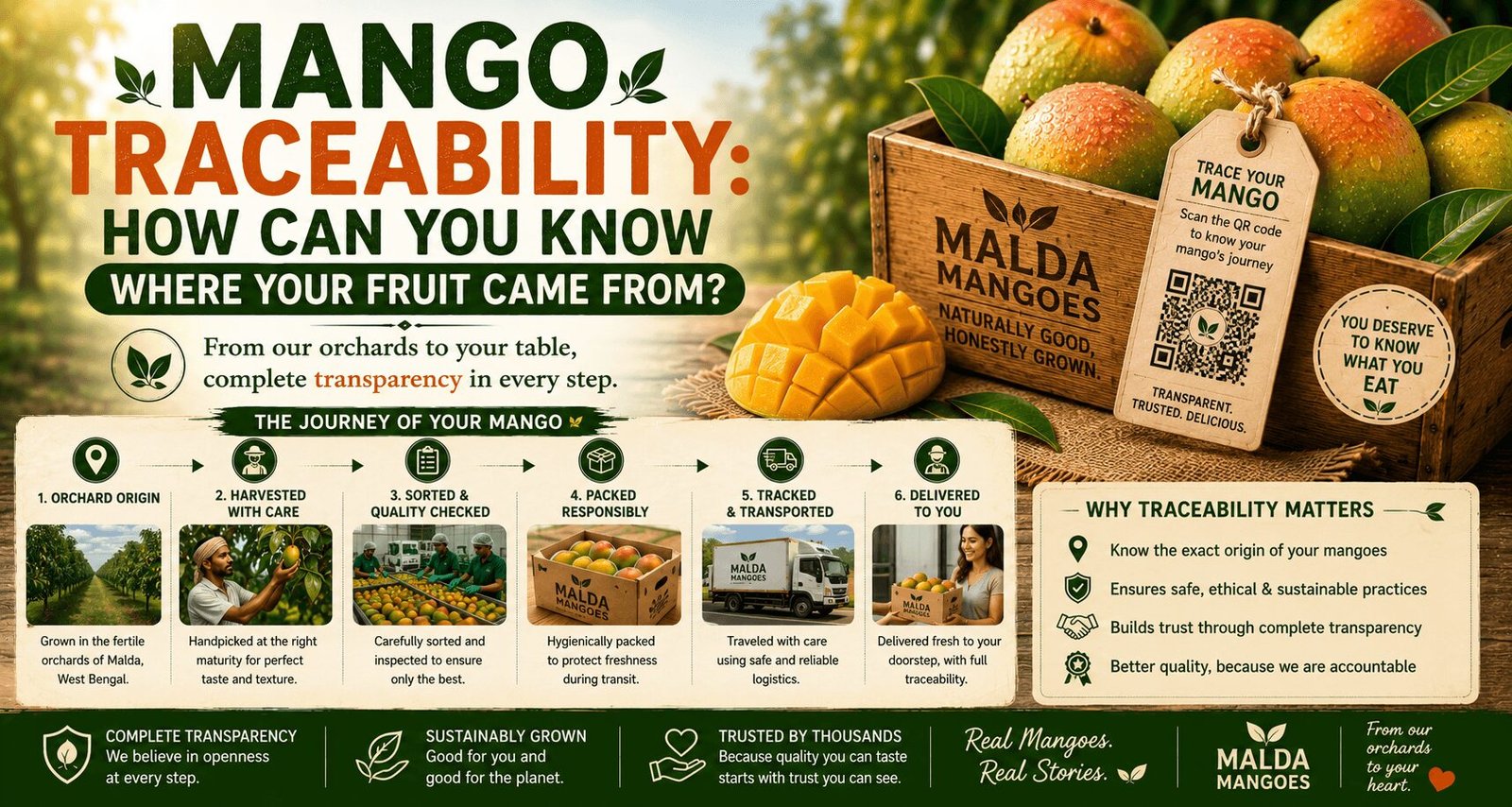
When you buy a box of mangoes, you may know the variety and price, but do you know where the fruit was actually grown?
Mango traceability helps answer that question.
From the orchard where mangoes are grown to the point where they are packed, transported, and delivered, different records can help connect the fruit with its source. For consumers, traceability provides greater transparency and makes it easier to understand the journey of the mangoes they purchase.
This is especially useful when buying regional varieties such as Malda mangoes, where the growing region can be an important part of the fruit’s identity.
What Is Mango Traceability?
Mango traceability is the ability to track fruit through different stages of the supply chain.
Depending on the supplier and system being used, traceability may connect mangoes with information such as:
- Farm or orchard.
- Grower or producer.
- Variety.
- Growing region.
- Harvest date.
- Batch or lot number.
- Packing facility.
- Packing date.
- Distribution information.
The level of information available can vary between suppliers.
Why Does Mango Traceability Matter?
Traceability provides several benefits for both businesses and consumers.
It can help:
- Identify the origin of fruit.
- Track batches through the supply chain.
- Improve quality control.
- Support consistent sourcing.
- Investigate quality issues.
- Improve supply-chain transparency.
- Give buyers more information about their purchase.
For premium fruit, knowing where it came from can also help consumers understand the characteristics they can expect.
1. Start With the Origin
The most basic traceability detail is the origin.
A label may identify:
- Country.
- State.
- District.
- Region.
- Growing area.
For example, if you are buying Malda mangoes, the origin information may identify Malda, West Bengal, as the growing region.
Origin is particularly important for mangoes because different regions are associated with different varieties and growing traditions.
2. Look for the Mango Variety
The variety is another important traceability detail.
A label may identify mangoes as:
- Himsagar.
- Fazli.
- Lakshmanbhog.
- Gopalbhog.
- Alphonso.
- Kesar.
- Dasheri.
- Langra.
Knowing the variety helps connect the fruit with its expected characteristics, including size, aroma, texture, sweetness, and fibre content.
3. Check the Grower or Producer Information
Some mango suppliers provide information about the grower, farm, orchard, or producer.
This can provide an additional layer of transparency.
Depending on the business model, consumers may be able to learn whether the mangoes were sourced:
- Directly from growers.
- Through a farming cooperative.
- From an orchard network.
- Through a wholesaler.
- Through another distribution channel.
Not every supplier provides individual farm information, so the available level of traceability can differ.
4. Understand Harvest Information
Harvest records can provide useful information about when mangoes were picked.
A harvest date can help businesses track:
- Fruit maturity.
- Batch movement.
- Storage periods.
- Distribution timelines.
However, the harvest date alone does not tell you the complete freshness story. Handling, storage, ripening, transportation, and delivery also influence the final condition of the fruit.
5. Check the Batch or Lot Number
A batch or lot number is one of the most useful traceability tools in commercial food supply chains.
It can connect a particular group of mangoes with production and handling records.
For example, a batch may be associated with:
Orchard → Variety → Harvest → Sorting → Packing → Distribution
If a quality issue occurs, businesses can use these records to identify the affected batch more efficiently.
6. Look at the Packing Information
Mangoes may be sorted and packed after harvesting.
The label may provide information such as:
- Packing date.
- Packing location.
- Batch number.
- Grade.
- Net weight.
- Variety.
This can help connect the packaged product with earlier stages of the supply chain.
7. Understand the Difference Between Origin and Packing Location
This is an important point for buyers.
The location where mangoes are packed is not necessarily the location where they were grown.
For example:
Grown in Malda, West Bengal → Packed elsewhere → Delivered to Delhi
In this case, the packing location should not be confused with the agricultural origin.
When you want to know where the mangoes were grown, look specifically for the origin or growing region.
8. How Labels Support Traceability
Mango labels can bring several pieces of information together.
Depending on the supplier, you may find:
| Label Information | What It Tells You |
|---|---|
| Variety | What type of mango you purchased |
| Origin | Where the mangoes were grown |
| Harvest Date | When the fruit was harvested |
| Packing Date | When the fruit was packed |
| Batch/Lot | Which production group it belongs to |
| Grade | Commercial quality classification |
| Weight | Quantity of fruit in the package |
| Producer/Packer | Who handled or supplied the fruit |
The more clearly these details are recorded, the easier it becomes to trace the fruit through the supply chain.
9. Can You Trace a Mango Back to a Specific Tree?
Usually, consumers should not assume that every mango can be traced to an individual tree.
The level of traceability depends on how the orchard and supply chain maintain their records.
A commercial batch may contain fruit from:
- One orchard.
- Multiple sections of an orchard.
- Several farms.
- A group of growers.
Therefore, “traceable” does not always mean “traceable to one specific tree.”
10. Technology Is Changing Mango Traceability
Modern supply chains can use digital systems to improve traceability.
Businesses may use:
- Digital farm records.
- QR codes.
- Barcode systems.
- Batch management software.
- Inventory systems.
- Digital harvest records.
A QR code on a package, for example, may potentially connect customers with additional information about the product, depending on how the supplier has implemented its system.
11. What a QR Code Can Tell You
Some food businesses use QR codes to provide additional product information.
A QR code may link to details such as:
- Product variety.
- Growing region.
- Producer information.
- Harvest details.
- Packing information.
- Product handling instructions.
However, simply having a QR code does not automatically prove the authenticity or quality of a product. Buyers should consider the reliability of the company providing the information.
12. Traceability and Mango Quality
Traceability and quality control are closely connected.
When suppliers maintain accurate records, they can better understand:
- Where fruit came from.
- When it was harvested.
- How it was handled.
- Which batches were packed together.
- Where those batches were distributed.
This can make it easier to investigate quality problems and improve future sourcing.
13. Traceability Can Help Reduce Supply-Chain Problems
If a quality issue is discovered in one batch, traceability records can help businesses identify the affected fruit more quickly.
Without proper records, identifying the source can be much more difficult.
Good traceability systems therefore support:
- Faster investigations.
- Better quality control.
- More targeted corrective actions.
- Improved supplier management.
14. Why Traceability Matters for Malda Mangoes
Malda has a long history of mango cultivation and is associated with several well-known varieties.
These include:
- Himsagar.
- Fazli.
- Lakshmanbhog.
- Gopalbhog.
- Khirsapati.
For consumers purchasing Malda mangoes, origin information can be especially valuable.
It helps distinguish mangoes genuinely sourced from the region from fruit that may simply be marketed using broad terms such as “Indian mangoes.”
Clear variety and origin information creates greater transparency.
15. What Buyers Should Ask When Purchasing Mangoes
If you want greater transparency, consider asking the seller:
Where were the mangoes grown?
Look for a specific growing region rather than only a country name.
Which variety is it?
Knowing the variety helps you understand what to expect.
When were they harvested?
Harvest information provides useful context about the fruit’s journey.
Where were they packed?
This helps distinguish growing origin from packing location.
Is there a batch or lot number?
Batch information can support traceability.
How were they handled and delivered?
Understanding the post-harvest process can help you assess the supplier’s approach to freshness.
16. What Makes Traceability More Reliable?
Good traceability depends on accurate records.
A reliable system should ideally connect information across multiple stages:
Farm → Harvest → Sorting → Grading → Packing → Storage → Transportation → Delivery
The more consistently these records are maintained, the easier it is to follow the fruit’s journey.
17. Traceability Does Not Automatically Mean Better Taste
It’s important to understand that traceability and taste are different concepts.
A traceable mango is not automatically sweeter or more flavorful.
Taste depends on factors such as:
- Variety.
- Growing conditions.
- Harvest maturity.
- Ripening.
- Storage.
- Handling.
Traceability provides transparency about the product’s journey; it does not by itself determine eating quality.
A Simple Mango Traceability Checklist
Before purchasing premium mangoes, look for:
- Clear variety name
- Specific growing origin
- Harvest or packing information
- Producer or supplier details
- Batch or lot information
- Transparent packaging
- Clear storage and handling guidance
- Reliable seller information
These details can help you understand where your mangoes came from and how they moved through the supply chain.
Common Misunderstandings About Mango Traceability
“Indian mango” tells me exactly where it came from.
Not necessarily. India is a large mango-producing country with many growing regions and varieties.
The packing location is the growing origin.
Not necessarily. Mangoes may be grown in one region and packed somewhere else.
A QR code proves authenticity.
A QR code can provide information, but buyers should also consider the reliability of the supplier and the information provided.
Traceability guarantees freshness.
Traceability helps track the product. Freshness also depends on harvesting, handling, storage, ripening, transportation, and delivery.
Final Thoughts
Mango traceability helps connect the fruit in your hands with the stages it passed through before reaching you.
By checking the variety, origin, harvest information, batch number, packing details, and producer information, buyers can gain a clearer understanding of where their mangoes came from.
For regional fruits such as Malda mangoes, this information can be particularly valuable. Knowing that your Himsagar, Fazli, Lakshmanbhog, Gopalbhog, or Khirsapati mangoes originated in the region associated with the variety adds transparency to the buying experience.
Ultimately, traceability is about knowing more about your food—from orchard to table.
Experience Premium Malda Mangoes
Experience the authentic taste of premium Malda Mangoes sourced directly from trusted orchards in West Bengal. Our Himsagar, Fazli, Lakshmanbhog, Gopalbhog, and Khirsapati mangoes are carefully sourced, handpicked at the appropriate maturity stage, naturally ripened, graded, quality-checked, and securely packed before delivery across India. With clear variety and origin information and careful handling throughout the supply chain, we help you understand where your mangoes come from while enjoying their naturally sweet flavor, rich aroma, smooth texture, and premium quality.