

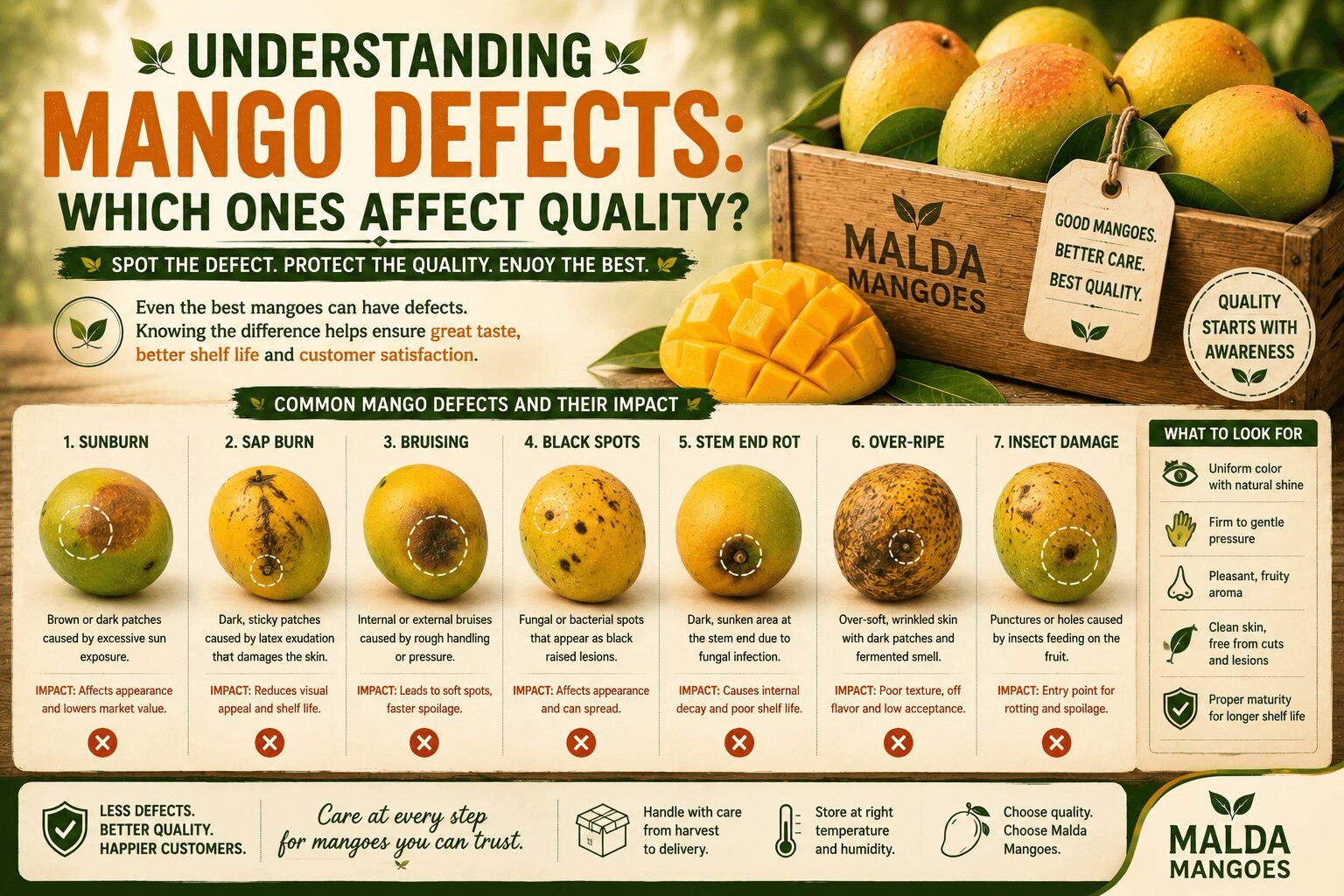
Not every mark on a mango means the fruit is poor quality. Mangoes are natural agricultural products, so small variations in skin color, shape, texture, and appearance are normal. However, some defects can affect freshness, shelf life, taste, texture, or food safety.
For buyers, the challenge is knowing the difference between a cosmetic imperfection and a defect that actually affects the quality of the fruit.
Professionals assess mangoes by looking at multiple characteristics, including appearance, firmness, maturity, physical damage, and signs of deterioration. Understanding these differences can help consumers make better purchasing decisions and avoid rejecting perfectly good mangoes simply because they do not look flawless.
What Is a Mango Defect?
A mango defect is any physical, physiological, biological, or handling-related condition that reduces the fruit’s appearance, quality, shelf life, or usability.
Defects can occur:
- While the mango is growing on the tree.
- During harvesting.
- During sorting and grading.
- During packing.
- During transportation.
- During storage.
- During ripening.
Not all defects have the same impact.
Some affect appearance only, while others can damage the flesh or accelerate spoilage.
Cosmetic vs. Quality-Affecting Defects
One of the most important distinctions is between cosmetic defects and quality defects.
Cosmetic defects
These may change how a mango looks without significantly affecting the edible pulp.
Examples can include:
- Minor skin marks.
- Small scars.
- Slight color variation.
- Natural surface blemishes.
- Minor shape irregularities.
Quality-affecting defects
These can affect the fruit’s internal quality, freshness, or shelf life.
Examples include:
- Deep bruising.
- Cuts.
- Rot.
- Mold.
- Severe pest damage.
- Excessive softness.
- Internal breakdown.
This distinction is important because a mango does not have to look perfect to taste excellent.
1. Minor Skin Marks
Small marks on mango skin are common.
They can result from:
- Natural growth.
- Contact with leaves or branches.
- Weather exposure.
- Handling.
- Minor abrasion.
If the skin is intact and the pulp remains healthy, a small cosmetic mark may have little impact on eating quality.
2. Scarring
Scarring can appear as rough or discolored areas on the skin.
Depending on its severity, scarring may be primarily cosmetic.
A shallow scar that does not penetrate the fruit may not significantly affect the edible portion.
However, deeper wounds require closer inspection because they can provide an entry point for microorganisms and accelerate deterioration.
3. Bruising
Bruising is more significant than many cosmetic marks.
It can occur when mangoes experience:
- Dropping.
- Compression.
- Rough handling.
- Impact during transportation.
A bruised mango may initially look acceptable from the outside but develop softer or darker flesh underneath the damaged area.
Gentle harvesting, careful packing, and appropriate transportation can help reduce bruising.
4. Cuts and Punctures
Cuts or punctures that break the skin can affect mango quality.
Open wounds can increase the risk of:
- Moisture loss.
- Microbial contamination.
- Faster deterioration.
- Internal discoloration.
Deep cuts are therefore more concerning than superficial marks.
5. Black Spots
Dark or black spots can have different causes.
A small superficial mark may be cosmetic, while expanding dark areas accompanied by softness or leakage can indicate deterioration.
When assessing a dark spot, consider:
- Size.
- Depth.
- Texture.
- Spread.
- Smell.
- Overall fruit condition.
A single dark mark should not automatically be treated as proof that the entire mango is spoiled.
6. Mold
Visible mold is a more serious defect.
Mold may appear as fuzzy or spreading growth on the surface and can indicate deterioration.
Mangoes showing significant mold should not be treated like fruit with a simple cosmetic blemish.
Proper storage and handling are important for reducing the risk of mold development.
7. Rot and Decay
Rot is one of the most significant mango defects.
Signs can include:
- Very soft areas.
- Darkening flesh.
- Unpleasant odor.
- Leakage.
- Rapid breakdown of the fruit.
Rot can affect both appearance and internal quality and can progress quickly under favorable conditions.
8. Shriveling
Shriveling occurs when mangoes lose moisture.
You may notice:
- Wrinkled skin.
- Reduced firmness.
- A less fresh appearance.
Mild wrinkling may occur as fruit ages, but significant shriveling can indicate declining freshness and quality.
9. Overripe or Extremely Soft Fruit
Softness is not always a defect.
A ripe mango naturally becomes softer as it reaches eating maturity.
The problem occurs when the fruit becomes:
- Excessively soft.
- Watery.
- Leaky.
- Fermented-smelling.
- Internally deteriorated.
Therefore, softness needs to be interpreted according to the mango’s ripeness stage.
10. Pest Damage
Insects and other pests can sometimes cause damage to mangoes during cultivation.
Visible pest damage may appear as:
- Small holes.
- Punctures.
- Scarring.
- Discoloration.
- Damaged areas.
The significance depends on the severity and whether the damage extends into the fruit.
Good orchard monitoring and integrated pest management help reduce pest-related problems.
11. Sun Damage
Mangoes exposed to intense sunlight can sometimes develop changes in skin appearance.
Sun-related damage may appear as:
- Discolored patches.
- Surface blemishes.
- Localized changes in skin texture.
Depending on its severity, this may be primarily cosmetic or may affect the fruit’s condition.
12. Sap Burn and Skin Irritation
Some mangoes can develop skin blemishes associated with contact with sap or other substances during harvesting and handling.
These marks can affect appearance without necessarily damaging the pulp.
Proper harvesting and post-harvest handling can help minimize such problems.
13. Misshapen Mangoes
Not every mango grows into a perfectly uniform shape.
Natural variation can result from:
- Variety.
- Weather.
- Pollination.
- Growing conditions.
- Tree development.
A misshapen mango can still have excellent flavor and pulp quality.
Shape becomes more important when fruit is being commercially graded for uniform appearance.
14. Skin Color Variation
Mango skin can naturally vary in color.
Depending on the variety, mature or ripe fruit may remain:
- Green.
- Yellow-green.
- Yellow.
- Orange.
- Red-blushed.
Color variation alone should not be considered a quality defect.
The variety and maturity stage should always be considered.
15. Internal Defects
Some mango defects cannot be identified simply by looking at the outside.
Internal problems can include:
- Discolored flesh.
- Tissue breakdown.
- Excessive fibre.
- Internal browning.
- Poor pulp development.
These conditions can be influenced by variety, growing conditions, maturity, storage, and other factors.
This is why professional quality assessment may include internal sampling when necessary.
Which Mango Defects Matter Most?
A simple way to understand defects is to group them by their likely impact.
| Defect | Typical Impact |
|---|---|
| Minor skin mark | Usually cosmetic |
| Small scar | Often cosmetic |
| Slight shape variation | Usually cosmetic |
| Color variation | Usually natural |
| Mild surface blemish | Often cosmetic |
| Bruising | Can affect pulp and shelf life |
| Deep cut | Can accelerate deterioration |
| Pest damage | Depends on severity |
| Severe shriveling | Can indicate declining freshness |
| Mold | Serious quality concern |
| Rot | Serious quality concern |
| Leakage | Often indicates damage or deterioration |
| Fermented smell | Possible overripe or deteriorating fruit |
Why Handling Can Cause Mango Defects
Some defects develop after the mango leaves the tree.
Rough handling during:
- Harvesting.
- Sorting.
- Packing.
- Loading.
- Transportation.
- Delivery.
can cause bruises, cuts, and compression damage.
This is why careful post-harvest management is just as important as good orchard practices.
How Professional Grading Handles Mango Defects
Professional grading generally considers the severity and type of defect rather than simply asking whether a mango looks perfect.
Factors may include:
- Size of the affected area.
- Depth of the defect.
- Location.
- Whether the skin is broken.
- Effect on the pulp.
- Impact on shelf life.
- Overall appearance.
This allows mangoes to be sorted according to appropriate commercial standards.
Do Small Mango Marks Mean the Fruit Is Bad?
No.
Natural fruits rarely have completely flawless surfaces.
A mango with a small scar or minor blemish can still have:
- Sweet pulp.
- Good aroma.
- Healthy texture.
- Excellent eating quality.
Instead of rejecting a mango based solely on appearance, buyers should check whether the defect affects the fruit’s firmness, smell, skin integrity, or internal condition.
How Buyers Can Check Mangoes for Defects
Before purchasing mangoes, use this simple checklist:
Look
Check for major cuts, mold, extensive dark patches, and leakage.
Feel
Gently check whether the firmness is appropriate for the desired ripeness.
Smell
Look for a pleasant natural aroma and avoid fruit with an unusual fermented smell.
Inspect
Check whether any visible defect is superficial or appears to extend deeper into the fruit.
Consider the variety
Remember that natural color, shape, and texture vary between mango varieties.
Mango Defects and Malda Mangoes
Malda in West Bengal is known for its rich mango-growing tradition and varieties such as:
- Himsagar.
- Fazli.
- Lakshmanbhog.
- Gopalbhog.
- Khirsapati.
Like all agricultural produce, Malda mangoes can naturally show minor variations in appearance.
A small surface mark does not necessarily reduce their eating quality. What matters is whether the fruit remains healthy, appropriately mature, aromatic, and free from serious deterioration.
For premium mangoes, careful sorting and grading help separate fruit according to its condition while minimizing unnecessary food waste.
How Better Handling Reduces Mango Defects
Mango quality can be protected by:
- Careful harvesting.
- Appropriate maturity at harvest.
- Gentle sorting.
- Protective packaging.
- Proper storage.
- Efficient transportation.
- Regular quality checks.
Reducing physical damage helps preserve the condition of mangoes throughout the supply chain.
Why Reducing Unnecessary Food Waste Matters
Strict cosmetic expectations can sometimes result in perfectly edible fruit being rejected.
A mango with a minor scar or unusual shape may still be delicious.
Understanding the difference between appearance and actual quality can encourage more responsible consumption and reduce unnecessary food waste.
Final Thoughts
Mango defects come in many forms, and not all of them have the same effect on quality.
Minor scars, natural color variations, and slight shape differences are often cosmetic. In contrast, deep bruises, open wounds, mold, rot, severe leakage, and significant deterioration can affect freshness, safety, and eating quality.
The key is to look beyond appearance. Consider the mango variety, firmness, aroma, maturity, skin condition, and overall health of the fruit before making a judgment.
A mango doesn’t have to be visually perfect to be delicious. What matters most is the condition of the fruit beneath the surface and how carefully it has been handled from orchard to table.
Experience Premium Malda Mangoes
Experience the authentic taste of premium Malda Mangoes sourced directly from trusted orchards in West Bengal. Our Himsagar, Fazli, Lakshmanbhog, Gopalbhog, and Khirsapati mangoes are carefully harvested, sorted, graded, quality-checked, naturally ripened, and securely packed before being delivered fresh across India. By focusing on maturity, fruit condition, careful handling, and quality control, we help preserve the naturally sweet flavor, rich aroma, smooth texture, and premium quality of authentic Malda mangoes.