

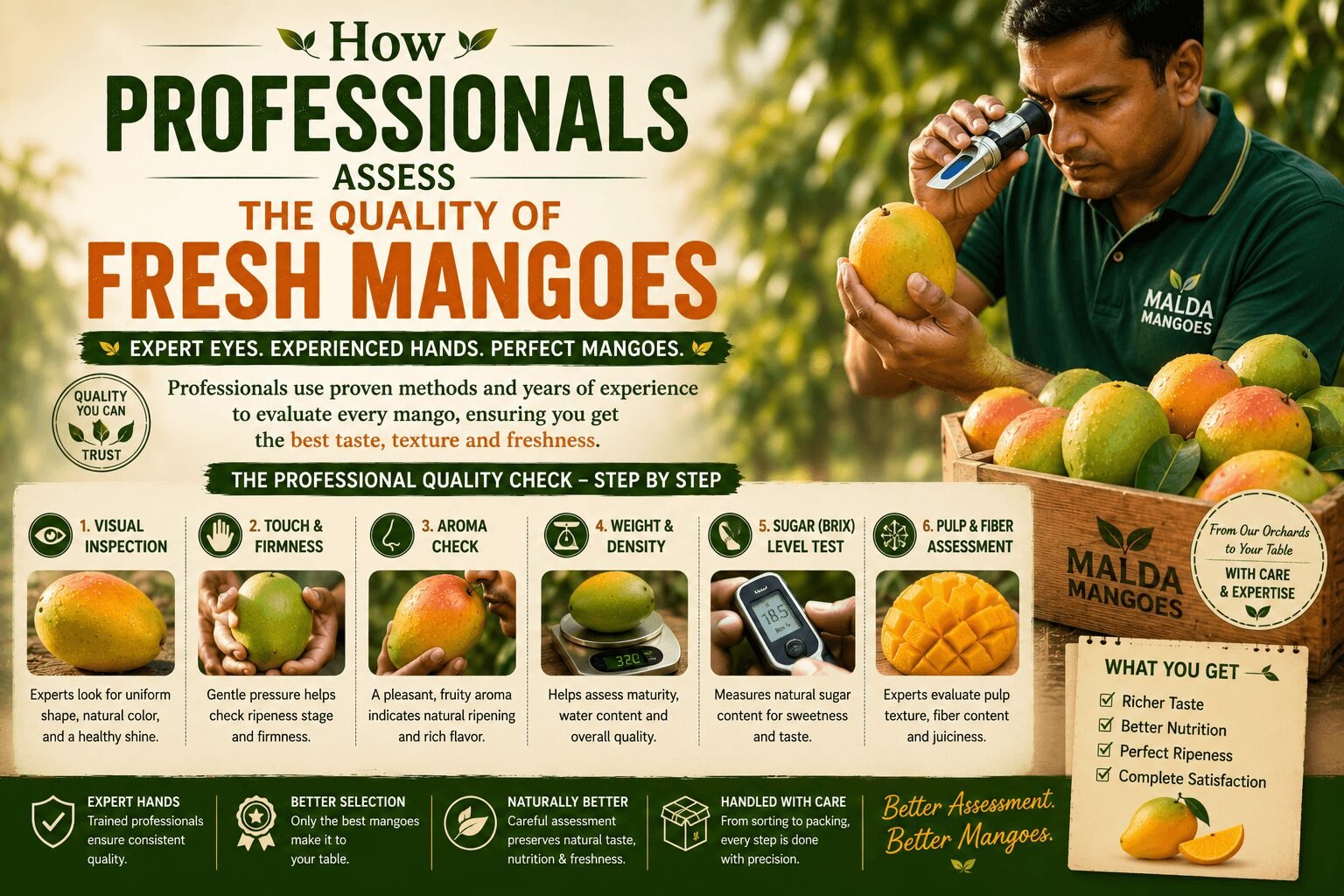
Choosing a good mango is more than simply looking for bright skin color or a large fruit. Professionals involved in mango farming, packing, distribution, and quality control use several characteristics to assess fruit quality before it reaches consumers.
A mango’s quality can be influenced by its variety, maturity, growing conditions, harvest timing, physical condition, handling, storage, and transportation. Since every variety has its own natural characteristics, professionals evaluate fruit according to appropriate standards rather than relying on a single visual feature.
Understanding these quality checks can help consumers become better mango buyers and appreciate the work that goes into delivering premium fruit.
What Does Mango Quality Mean?
Mango quality refers to the overall condition and characteristics of the fruit.
Professional quality assessment may consider:
- Variety.
- Maturity.
- Size and weight.
- Shape.
- Skin condition.
- Firmness.
- Aroma.
- Pulp quality.
- Defects.
- Cleanliness.
- Handling and storage condition.
The importance of each factor can vary depending on the mango variety and its intended market.
1. Variety Identification
The first step is often identifying the mango variety.
Different varieties naturally differ in:
- Size.
- Shape.
- Skin color.
- Pulp texture.
- Fibre content.
- Aroma.
- Sweetness.
- Ripening behavior.
For example, Himsagar, Fazli, Alphonso, Kesar, Dasheri, and Langra all have different characteristics.
Professionals therefore compare mangoes against the expected characteristics of their particular variety.
2. Assessing Maturity
Maturity is one of the most important quality factors.
A mango harvested too early may struggle to develop its expected flavor and texture, while fruit that is too mature may have a shorter storage and transportation window.
Professionals may consider:
- Fruit development.
- Firmness.
- External appearance.
- Variety-specific maturity indicators.
- Harvest timing.
The objective is to identify fruit that has reached an appropriate maturity stage for its intended journey.
3. Checking Firmness
Firmness provides useful information about the mango’s maturity and condition.
Professionals may assess whether fruit is:
- Too hard.
- Appropriately firm.
- Beginning to soften.
- Too soft.
- Showing localized soft spots.
For commercial quality assessment, firmness may also be measured using specialized equipment rather than only by hand.
4. Examining Skin Appearance
The skin is carefully inspected for visible defects.
Quality checks can include looking for:
- Cuts.
- Bruises.
- Scarring.
- Black spots.
- Sun damage.
- Pest damage.
- Shriveling.
- Mold.
- Leakage.
Not every mark automatically makes a mango poor quality. Some cosmetic variations are natural, and acceptable standards depend on the market and grade.
5. Looking Beyond Skin Color
Color can provide useful information, but it is not a universal indicator of mango quality.
Different varieties naturally develop different skin colors as they mature and ripen.
Some may become:
- Yellow.
- Orange.
- Red-blushed.
- Yellow-green.
- Predominantly green.
Professionals therefore use color together with other characteristics instead of treating it as the sole indicator.
6. Evaluating Aroma
A mango’s aroma can provide clues about maturity and overall condition.
Professionals may look for the characteristic fragrance expected from the variety.
A pleasant fruity aroma can indicate developing ripeness, while an unusual fermented or sour smell may indicate deterioration.
7. Checking Size and Weight
Mangoes are often sorted according to size and weight.
Professionals may compare fruit against specified size categories to create more uniform batches.
Weight can also provide information about:
- Commercial grade.
- Pack configuration.
- Expected yield.
- Consistency within a shipment.
However, larger fruit does not automatically mean better flavor.
8. Examining Shape
Each mango variety has a typical shape.
Professionals may check whether fruit generally matches the expected characteristics of its variety.
Mangoes can be:
- Oval.
- Round.
- Elongated.
- Broad.
- Long and slender.
Natural variation is expected, so shape is considered along with other quality characteristics.
9. Checking for Physical Damage
Handling is particularly important because mangoes can be damaged by impact and excessive pressure.
Professionals inspect fruit for:
- Bruising.
- Cracking.
- Punctures.
- Cuts.
- Compression damage.
Damage may become more noticeable as the fruit ripens, which is why careful handling throughout the supply chain matters.
10. Assessing Internal Quality
External appearance doesn’t always tell the entire story.
Professional quality-control operations may use different methods to evaluate internal characteristics, depending on the purpose and scale of inspection.
Internal quality can include:
- Pulp color.
- Texture.
- Fibre content.
- Juiciness.
- Flavor.
- Internal defects.
Some commercial quality assessments may use sampling and laboratory or instrumental methods rather than cutting every fruit.
11. Checking for Ripeness Uniformity
When mangoes are packed together, consistent maturity can be important.
A shipment containing mangoes at widely different ripening stages may be more difficult to manage.
Professionals may therefore aim for suitable uniformity in:
- Maturity.
- Size.
- Variety.
- Overall condition.
This helps create a more consistent customer experience.
12. Assessing Cleanliness
Mangoes are also inspected for unwanted materials or visible contamination.
Quality-control checks can look for:
- Soil.
- Debris.
- Plant material.
- Insects.
- Other foreign matter.
Clean handling and appropriate packaging help maintain product quality during distribution.
13. Reviewing Harvest and Traceability Information
Professional mango operations often maintain records that connect fruit with its source.
Information may include:
- Harvest date.
- Orchard or grower.
- Variety.
- Batch or lot number.
- Packing date.
- Distribution information.
Traceability can make it easier to monitor quality and address issues when necessary.
14. Evaluating Packaging
Quality assessment doesn’t stop with the mango itself.
Packaging is also important.
Professionals consider whether packaging:
- Protects fruit from impact.
- Allows appropriate ventilation.
- Prevents excessive movement.
- Supports safe transportation.
- Maintains product presentation.
Good packaging can help preserve the condition established in the orchard.
15. Considering Transportation Conditions
Mango quality can change during transportation.
Professionals may monitor factors such as:
- Temperature.
- Handling.
- Travel duration.
- Loading conditions.
- Unloading procedures.
The goal is to minimize unnecessary stress and physical damage during the journey from orchard to customer.
16. Quality Standards Can Differ by Market
There isn’t always one universal definition of a “high-quality mango.”
Requirements can differ depending on whether mangoes are intended for:
- Local markets.
- Retail stores.
- Wholesale distribution.
- Food processing.
- Premium gifting.
- Domestic shipping.
- Export markets.
The desired size, appearance, maturity, and packaging can therefore vary.
Mango Quality Assessment Checklist
Professionals may consider the following factors when evaluating a batch:
| Quality Factor | What Is Assessed |
|---|---|
| Variety | Correct identification and expected characteristics |
| Maturity | Appropriate development stage |
| Firmness | Suitable firmness for handling and ripening |
| Appearance | Overall skin condition |
| Size | Weight and size consistency |
| Shape | Typical variety characteristics |
| Aroma | Natural and appropriate fragrance |
| Defects | Bruising, cuts, decay, or other damage |
| Pulp | Texture, color, fibre, and condition |
| Cleanliness | Absence of unwanted material |
| Packaging | Protection during transportation |
| Traceability | Harvest, batch, origin, and packing information |
Why Professional Quality Assessment Matters
Quality assessment helps connect what happens in the orchard with what consumers experience at home.
It can help businesses:
- Maintain consistent product standards.
- Separate damaged fruit.
- Create uniform batches.
- Improve packaging.
- Reduce avoidable losses.
- Track fruit through the supply chain.
- Deliver a more reliable product.
For consumers, these processes provide an additional layer of confidence when purchasing fresh mangoes.
How Professionals Assess Malda Mangoes
Malda in West Bengal is well known for its mango-growing heritage and diverse varieties.
Popular varieties associated with the region include:
- Himsagar.
- Fazli.
- Lakshmanbhog.
- Gopalbhog.
- Khirsapati.
Each variety has its own expected characteristics.
For example, Himsagar is known for its smooth pulp, rich flavor, and relatively low fibre content, while Fazli is recognized for its large fruit size and generous pulp.
Professional assessment therefore considers whether the mango meets the characteristics expected of its particular variety rather than applying the same visual standards to every mango.
Can Consumers Assess Mango Quality Like Professionals?
You don’t need specialized equipment to perform a basic quality check at home.
Start with five simple observations:
1. Look — Check the overall appearance and skin condition.
2. Smell — Look for a pleasant, natural mango aroma.
3. Feel — Gently assess firmness.
4. Identify — Know the mango variety and its expected characteristics.
5. Check the source — Look for reliable information about origin, harvesting, handling, and packaging.
These simple steps won’t replace professional testing, but they can help you make better purchasing decisions.
Common Misconceptions About Mango Quality
“The brightest mango is always the best.”
Not necessarily. Skin color varies naturally between varieties.
“The biggest mango has the most flavor.”
Size does not automatically determine sweetness or aroma.
“A few marks mean the mango is bad.”
Minor cosmetic imperfections may not affect the edible pulp.
“Soft means perfectly ripe.”
Excessive softness can indicate overripe or damaged fruit.
“Fresh means recently harvested.”
Freshness depends on more than harvest date. Handling, storage, transportation, and ripening all matter.
Final Thoughts
Professional mango quality assessment involves much more than looking at the fruit’s color.
Experts consider variety, maturity, firmness, appearance, size, shape, aroma, physical defects, internal quality, packaging, handling, and traceability to determine whether mangoes meet the required standards.
For consumers, understanding these principles can make mango shopping easier. Instead of relying on one visual clue, look at the complete picture.
A high-quality mango is the result of careful work at every stage—from orchard management and harvesting to sorting, packing, transportation, and delivery.
Experience Premium Malda Mangoes
Experience the authentic taste of premium Malda Mangoes sourced directly from trusted orchards in West Bengal. Our Himsagar, Fazli, Lakshmanbhog, Gopalbhog, and Khirsapati mangoes are handpicked at the appropriate maturity stage, naturally ripened, carefully graded, thoroughly quality-checked, and securely packed before being delivered fresh across India. Every batch is handled with attention to variety, maturity, appearance, freshness, and overall condition to preserve the naturally sweet flavor, rich aroma, smooth texture, and premium quality of Malda mangoes.