

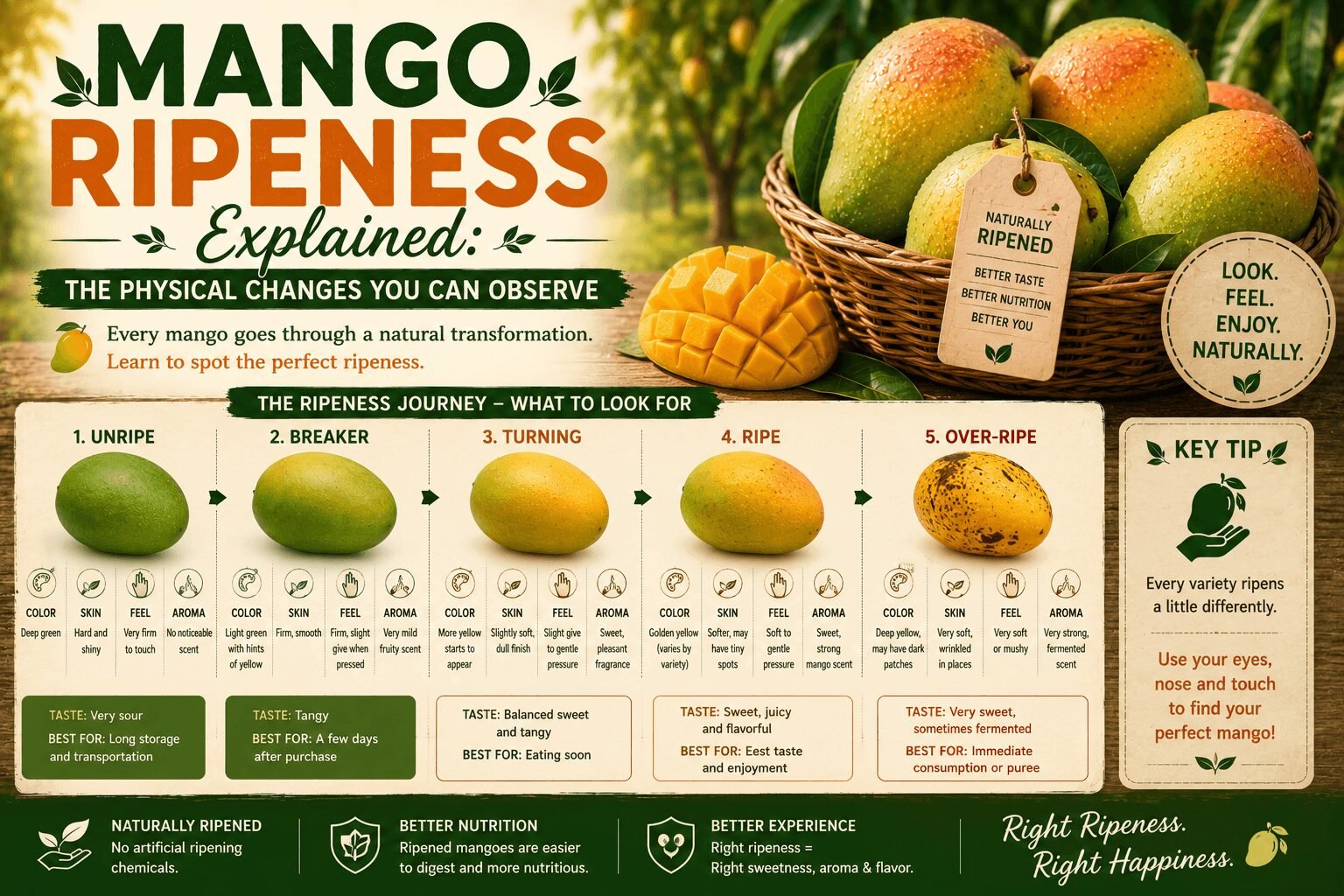
Knowing when a mango is ripe can make a big difference to your eating experience. An underripe mango may be firm and tart, while an overripe one can become excessively soft and develop unwanted flavors. Understanding the physical changes that happen as mangoes ripen can help you know when the fruit is ready to enjoy.
Mango ripening is a natural process in which the fruit undergoes several changes. Its texture becomes softer, its aroma becomes stronger, and its flavor develops as the fruit moves toward eating maturity.
However, not every mango changes in exactly the same way. Different varieties can have different skin colors, shapes, textures, and ripening characteristics.
Let’s explore the physical changes you can observe as a mango ripens.
What Happens When a Mango Ripens?
Ripening is a natural process that changes the physical and sensory characteristics of mangoes.
During ripening, you may notice changes in:
- Firmness.
- Skin appearance.
- Aroma.
- Pulp texture.
- Color.
- Flavor.
- Juiciness.
These changes happen gradually rather than all at once.
1. Firmness Begins to Change
One of the easiest ways to observe mango ripeness is by gently checking its firmness.
An unripe mango is generally:
- Very firm.
- Hard to gentle pressure.
- Less aromatic.
As ripening progresses, the flesh gradually softens.
A ripe mango usually has a slight amount of give when gently pressed. It should not necessarily feel extremely soft or mushy.
Important tip
Avoid squeezing mangoes repeatedly or with excessive pressure. Rough handling can bruise the fruit and affect its quality.
2. Aroma Becomes Stronger
Aroma is another useful sign of ripeness.
As mangoes mature and ripen, they often develop a stronger fruity fragrance, particularly around the stem area.
An unripe mango may have little noticeable aroma, while a ripe mango can smell:
- Sweet.
- Fruity.
- Fresh.
- Characteristically mango-like.
A fermented or unpleasant smell, however, can indicate that the fruit has become overripe or started deteriorating.
3. Skin Color May Change
Skin color can change during mango ripening, but it should not be used as the only indicator.
Depending on the variety, ripe mangoes may appear:
- Green.
- Yellow-green.
- Yellow.
- Orange.
- Red-blushed.
Some varieties remain relatively green even when fully ripe.
This is why buyers should consider skin color together with firmness and aroma.
4. The Skin May Become Slightly Softer
As the fruit ripens, the skin and flesh gradually become less firm.
You may notice that the mango feels slightly softer compared with when it was first harvested.
However, excessive softness combined with dark patches, leaking juice, or an unpleasant smell may indicate deterioration rather than ideal ripeness.
5. The Pulp Becomes Softer
One of the most noticeable changes happens inside the fruit.
As mangoes ripen, their pulp generally becomes:
- Softer.
- Juicier.
- Smoother.
- Easier to cut or scoop.
The exact texture depends on the variety.
Some mangoes naturally have very smooth, fibre-light pulp, while others contain more fibre.
6. Sweetness Develops
Mangoes generally become sweeter as they ripen.
During the ripening process, stored carbohydrates are converted into simpler sugars, contributing to the characteristic sweetness of ripe mangoes.
The final sweetness depends on several factors, including:
- Variety.
- Growing conditions.
- Harvest maturity.
- Ripening conditions.
This is why mangoes from different varieties can taste very different even when equally ripe.
7. Acidity Becomes Less Noticeable
An unripe mango can have a distinctly tart or acidic flavor.
As ripening progresses, acidity generally becomes less prominent while sweetness and characteristic mango flavor become more noticeable.
This creates the balanced sweet and aromatic taste associated with ripe mangoes.
8. The Fruit Becomes More Aromatic
Ripening also affects the volatile compounds responsible for a mango’s characteristic aroma.
As these compounds develop, the fruit can become increasingly fragrant.
This is one reason a ripe mango can often be recognized by smell before it is cut open.
9. The Flesh Changes Texture
The texture of mango pulp can provide another indication of ripeness.
An underripe mango may have:
- Firm flesh.
- A crunchy texture.
- Less juice.
- More pronounced tartness.
A ripe mango generally has:
- Softer flesh.
- More juice.
- A smoother mouthfeel.
- Stronger sweetness.
Again, natural texture varies by variety.
10. The Stem Area Can Provide Clues
The area around the stem can be useful when checking mango ripeness.
A stronger fruity aroma around the stem may suggest that the mango is approaching eating maturity.
However, the stem area should be considered alongside firmness and overall fruit condition rather than used as a standalone test.
Mango Ripeness Stages at a Glance
| Ripeness Stage | Firmness | Aroma | Flavor | Typical Condition |
|---|---|---|---|---|
| Unripe | Very firm | Mild | Tart | Needs more ripening |
| Ripening | Slightly softening | Increasing | Developing | Approaching maturity |
| Ripe | Slightly soft | Fruity and noticeable | Sweet and aromatic | Ready to eat |
| Overripe | Very soft | May become fermented | Can lose freshness | Best consumed quickly or avoided if deteriorated |
Why Mango Variety Matters
There is no universal visual test that works perfectly for every mango.
Different varieties naturally have different characteristics.
For example:
Himsagar
Known for its smooth pulp, rich flavor, and relatively low fibre content.
Fazli
Known for its large size and generous pulp.
Alphonso
Recognized for its rich aroma, creamy texture, and distinctive flavor.
Kesar
Known for its characteristic sweetness, aroma, and saffron-orange pulp.
Because these varieties differ naturally, buyers should learn the normal characteristics of the specific variety they are purchasing.
Can a Green Mango Be Ripe?
Yes.
This is an important point for mango buyers.
Some mango varieties can remain predominantly green even when they are ripe and ready to eat.
Therefore, a green skin does not automatically mean that a mango is unripe.
Instead, check:
Firmness + Aroma + Overall Condition + Variety
This combination provides a better indication of ripeness.
How to Ripen Mangoes at Home
If your mangoes are still firm after delivery, allow them to ripen naturally according to the seller’s instructions.
Keep them in an appropriate room-temperature environment and check them periodically.
As they ripen, observe:
- Increasing aroma.
- Slight softening.
- Changes in texture.
- Development of sweetness.
Once ripe, mangoes can generally be refrigerated to slow further ripening.
Signs That a Mango Is Overripe
A mango may have passed its ideal eating stage if you notice:
- Excessive softness.
- Leaking juice.
- Strong fermented smell.
- Extensive darkened areas.
- Mold.
- Unusual internal discoloration.
A small cosmetic mark does not necessarily mean the fruit is spoiled, but significant deterioration should be treated differently.
Common Mistakes When Checking Mango Ripeness
Mistake 1: Judging only by color
Different varieties have different natural skin colors.
Mistake 2: Squeezing too hard
Excessive pressure can bruise mangoes.
Mistake 3: Expecting every variety to ripen identically
Ripening characteristics vary between varieties.
Mistake 4: Ignoring aroma
Fragrance can provide a useful clue about ripening.
Mistake 5: Confusing softness with perfect ripeness
Extremely soft fruit may be overripe rather than ideally ripe.
Why Harvest Maturity Matters
Mangoes are often harvested at a mature stage and continue ripening after harvest.
Harvesting at the appropriate maturity helps the fruit develop its expected:
- Flavor.
- Texture.
- Aroma.
- Sweetness.
This makes careful harvest timing an important part of producing high-quality mangoes.
Understanding Ripeness in Malda Mangoes
Malda in West Bengal is known for its rich mango-growing heritage and varieties such as:
- Himsagar.
- Fazli.
- Lakshmanbhog.
- Gopalbhog.
- Khirsapati.
Each variety has its own natural appearance and ripening behavior.
For example, buyers should not expect every Malda mango to develop the same skin color or firmness when ripe. Understanding the characteristics of the specific variety makes it easier to identify its ideal eating stage.
Why Proper Ripening Matters for Flavor
The best mango experience comes from eating the fruit at the right stage.
When properly ripe, mangoes can offer:
- Natural sweetness.
- Rich aroma.
- Smooth texture.
- Juicy pulp.
- Characteristic varietal flavor.
This is why patience can be important when mangoes arrive slightly firm.
Final Thoughts
Mango ripeness is a gradual process that can be observed through several physical and sensory changes. Firmness decreases, aroma develops, pulp becomes softer, sweetness increases, and the fruit’s characteristic flavor becomes more noticeable.
However, there is no single sign that works for every mango. Skin color can vary by variety, and some ripe mangoes may remain predominantly green.
The best approach is to consider firmness, aroma, texture, appearance, and variety together. With a little practice, you’ll become much better at recognizing when a mango has reached its ideal eating stage.
Experience Premium Malda Mangoes
Experience the authentic taste of premium Malda Mangoes sourced directly from trusted orchards in West Bengal. Our Himsagar, Fazli, Lakshmanbhog, Gopalbhog, and Khirsapati mangoes are handpicked at the appropriate maturity stage, naturally ripened, carefully graded, thoroughly quality-checked, and securely packed before being delivered fresh across India. From careful harvesting to natural ripening, every step is managed to preserve the mango’s exceptional freshness, rich aroma, naturally sweet flavor, and premium quality.