

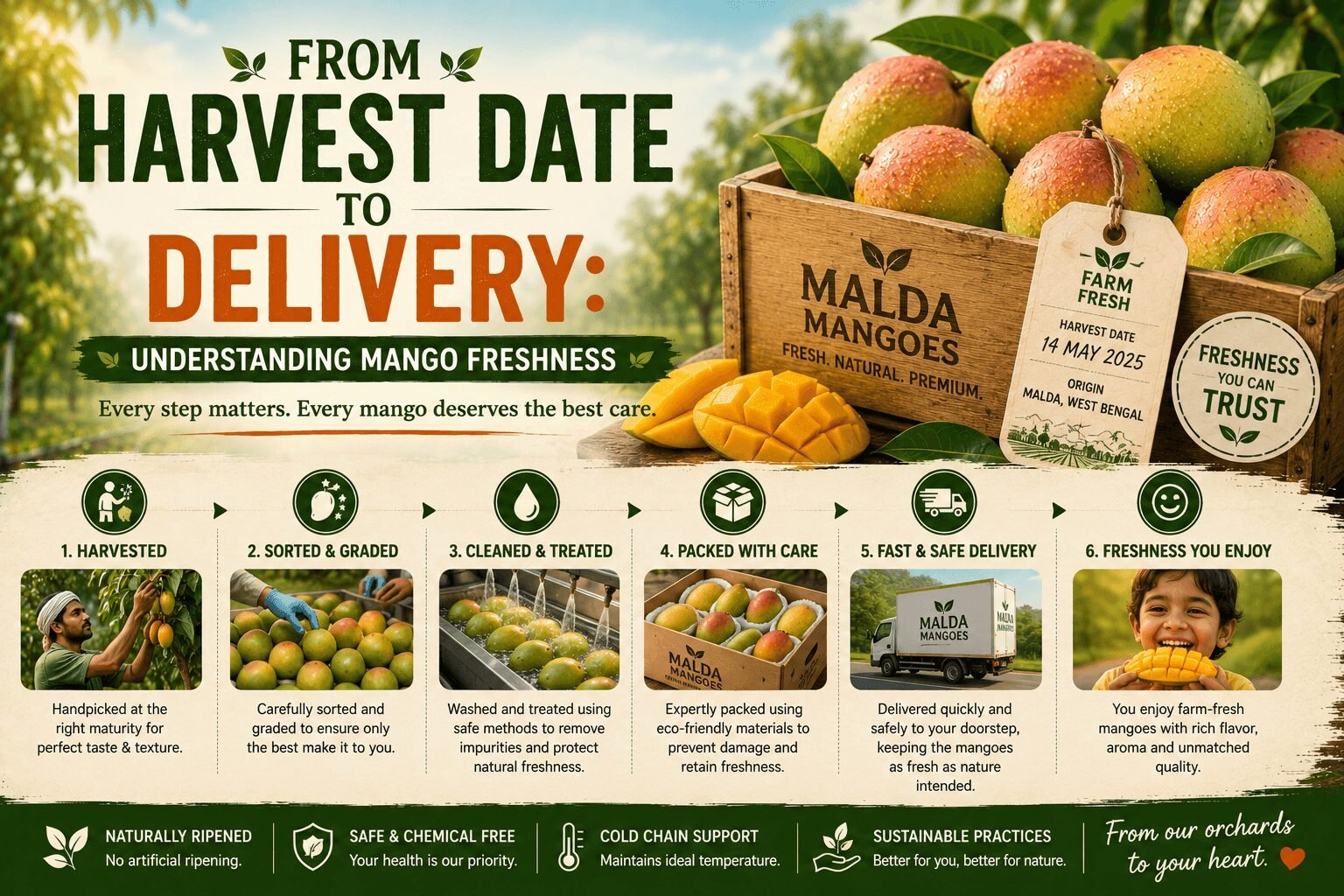
When you order a box of fresh mangoes, the journey from orchard to doorstep has already involved several important stages. From the moment a mango is harvested to the time it reaches your kitchen, harvesting maturity, handling, ripening, packaging, storage, and transportation can all influence its freshness and eating quality.
Understanding this journey helps explain why two mangoes harvested at different times—or handled differently after harvest—may have different textures, aromas, and flavors.
For mango lovers, freshness is not simply about how recently the fruit was picked. It is about how well the fruit has been managed throughout its journey.
What Does Mango Freshness Actually Mean?
Mango freshness refers to the overall condition of the fruit as it moves from harvest to consumption.
Fresh mangoes should generally maintain:
- Good firmness for their ripening stage.
- Pleasant natural aroma.
- Healthy skin.
- Good pulp texture.
- Natural sweetness.
- Minimal bruising or damage.
The exact characteristics depend on the mango variety and its stage of ripening.
1. It Starts With the Right Harvest Stage
The freshness journey begins in the orchard.
Mangoes are often harvested when they have reached an appropriate level of maturity rather than waiting until they become fully soft and ready to eat on the tree.
This allows the fruit to continue its natural ripening process after harvest.
Harvest timing can influence:
- Flavor development.
- Texture.
- Aroma.
- Shelf life.
- Ability to withstand transportation.
Experienced growers therefore pay close attention to the maturity of the fruit before harvesting.
2. Harvest Date vs. Ripening Date
One important distinction for buyers is that the harvest date is not necessarily the same as the eating date.
A mango can be harvested when mature and then continue ripening.
During this process, the fruit gradually changes in:
- Firmness.
- Aroma.
- Texture.
- Color.
- Sweetness.
This is why a mango harvested several days earlier may still be perfectly fresh when it reaches the consumer.
3. Gentle Harvesting Protects Freshness
Mangoes can be sensitive to rough handling.
After months of orchard care, improper harvesting can cause:
- Bruising.
- Cuts.
- Skin damage.
- Internal deterioration.
Growers may use careful picking methods and suitable collection equipment to minimize physical damage.
Gentle harvesting is one of the first steps in protecting mango quality.
4. Sorting and Grading
After harvesting, mangoes are usually inspected and sorted.
Depending on the operation, fruit may be assessed for:
- Size.
- Maturity.
- Appearance.
- Physical condition.
- Variety.
- Quality.
Damaged or unsuitable fruit can be separated from fruit intended for premium packing.
Grading helps create more consistent batches for customers.
5. Natural Ripening After Harvest
Many mango varieties continue to ripen naturally after being harvested at the appropriate maturity stage.
As the fruit ripens:
- The flesh becomes softer.
- Aroma becomes stronger.
- Flavor develops.
- Sweetness becomes more noticeable.
The rate of ripening can vary according to variety, temperature, maturity, and storage conditions.
6. Packaging Matters
Packaging plays an important role in protecting mangoes during delivery.
Good packaging helps reduce:
- Physical impact.
- Bruising.
- Compression.
- Unnecessary movement.
- Exposure to unsuitable conditions.
Protective packaging is especially important when mangoes are transported over long distances.
7. Temperature and Storage Conditions
Temperature can influence the rate at which mangoes ripen.
Storage and transportation conditions need to be managed according to the maturity and requirements of the fruit.
If mangoes are exposed to unsuitable conditions, their quality may be affected.
This is why proper storage and transportation planning are important parts of the freshness journey.
8. Transportation From Orchard to Customer
Mangoes can travel significant distances before reaching consumers.
During transportation, suppliers need to consider:
- Travel time.
- Packaging.
- Temperature.
- Handling.
- Loading and unloading.
- Delivery schedules.
Reducing unnecessary delays helps mangoes reach customers in better condition.
9. Why Delivery Time Matters
The time between packing and delivery can influence the stage at which mangoes arrive.
For example:
Earlier delivery:
The mango may arrive firmer and continue ripening at home.
Later delivery:
The mango may arrive closer to its ready-to-eat stage.
This is why delivery planning is particularly important for fresh fruit.
10. How to Check Mango Freshness When It Arrives
Once your mangoes arrive, inspect them carefully.
Check the aroma
A pleasant fruity fragrance is often a good sign that the mango is progressing through ripening.
Check firmness
The fruit should have firmness appropriate for its ripening stage.
Inspect the skin
Look for major bruises, cuts, leakage, mold, or other signs of deterioration.
Check the overall condition
Mangoes should be handled gently and stored appropriately after delivery.
11. What Should You Do After Delivery?
If the mangoes are still firm, allow them to ripen according to the seller’s instructions.
Once ripe, mangoes can generally be refrigerated to slow further ripening.
Avoid repeatedly squeezing the fruit because excessive pressure can cause bruising.
For the best eating experience, consume mangoes according to their ripeness rather than simply relying on the number of days since delivery.
12. Why Variety Matters
Different mango varieties have different ripening characteristics.
For example, popular Indian varieties such as:
- Himsagar.
- Alphonso.
- Kesar.
- Dasheri.
- Langra.
- Chausa.
- Fazli.
may differ in size, firmness, aroma, texture, and ripening behavior.
Therefore, there is no single freshness timeline that applies to every mango.
13. Origin Can Influence the Freshness Journey
The growing region also matters because it affects the distance and logistics involved in getting mangoes to consumers.
Malda in West Bengal, for example, is famous for varieties such as:
- Himsagar.
- Fazli.
- Lakshmanbhog.
- Gopalbhog.
- Khirsapati.
When these mangoes are sourced directly from the region, careful post-harvest handling and efficient delivery become especially important when serving customers in other parts of India.
14. Why Farm-to-Doorstep Handling Matters
The fewer unnecessary steps between harvesting and delivery, the easier it can be to maintain product quality.
A well-managed supply chain focuses on:
Orchard → Harvest → Sorting → Grading → Packing → Transportation → Delivery → Customer
Each stage has a role in maintaining the quality of the fruit.
15. Freshness Is More Than the Harvest Date
A common misconception is that the newest harvest automatically means the freshest mango.
In reality, freshness depends on several factors:
- Harvest maturity.
- Handling.
- Ripening.
- Packaging.
- Storage.
- Transportation.
- Delivery time.
A mango harvested at the right maturity and carefully handled can remain excellent through its journey to the customer.
Mango Freshness Checklist
When buying mangoes, consider these factors:
| Factor | Why It Matters |
|---|---|
| Harvest stage | Determines how the fruit develops after picking |
| Variety | Influences flavor, texture, and ripening |
| Handling | Helps prevent bruising and physical damage |
| Grading | Supports consistent quality |
| Packaging | Protects fruit during transportation |
| Storage | Helps manage ripening |
| Transportation | Influences delivery condition |
| Delivery time | Affects the ripening stage on arrival |
| Post-delivery storage | Helps preserve quality at home |
Why Malda Mangoes Require Careful Handling
Malda’s mango-growing heritage is closely associated with premium varieties such as Himsagar, Fazli, Lakshmanbhog, Gopalbhog, and Khirsapati.
These mangoes are valued for their distinctive flavors and aromas, but preserving those qualities requires careful management after harvest.
From selecting the appropriate harvest stage to sorting, grading, packing, and transporting the fruit, every step contributes to the final eating experience.
Common Mistakes That Can Reduce Mango Freshness
Ignoring maturity
Harvesting or buying fruit at an inappropriate maturity stage can affect the eventual eating quality.
Rough handling
Excessive pressure and impact can cause bruising.
Poor storage
Unsuitable storage conditions can accelerate deterioration or affect ripening.
Delayed transportation
Unnecessary delays can affect the condition of fresh fruit.
Improper home storage
Storing mangoes incorrectly after delivery can interfere with their natural ripening process.
Final Thoughts
Mango freshness is the result of a journey, not a single date on a calendar.
From selecting the right harvest stage and carefully picking the fruit to sorting, grading, packaging, transporting, and delivering it, every stage can influence the quality of the mango you eventually enjoy.
The harvest date provides useful information, but it should always be considered alongside variety, maturity, handling, storage, and transportation.
When these elements are managed carefully, mangoes can travel from orchard to doorstep while retaining the natural aroma, texture, and sweetness that make them one of India’s most loved fruits.
Experience Premium Malda Mangoes
Experience the authentic taste of premium Malda Mangoes sourced directly from trusted orchards in West Bengal. Our Himsagar, Fazli, Lakshmanbhog, Gopalbhog, and Khirsapati mangoes are handpicked at the appropriate maturity stage, naturally ripened, carefully graded, thoroughly quality-checked, and securely packed before being delivered fresh across India. From orchard to doorstep, every stage is handled with care to preserve exceptional freshness, rich aroma, naturally sweet flavor, and premium quality.