

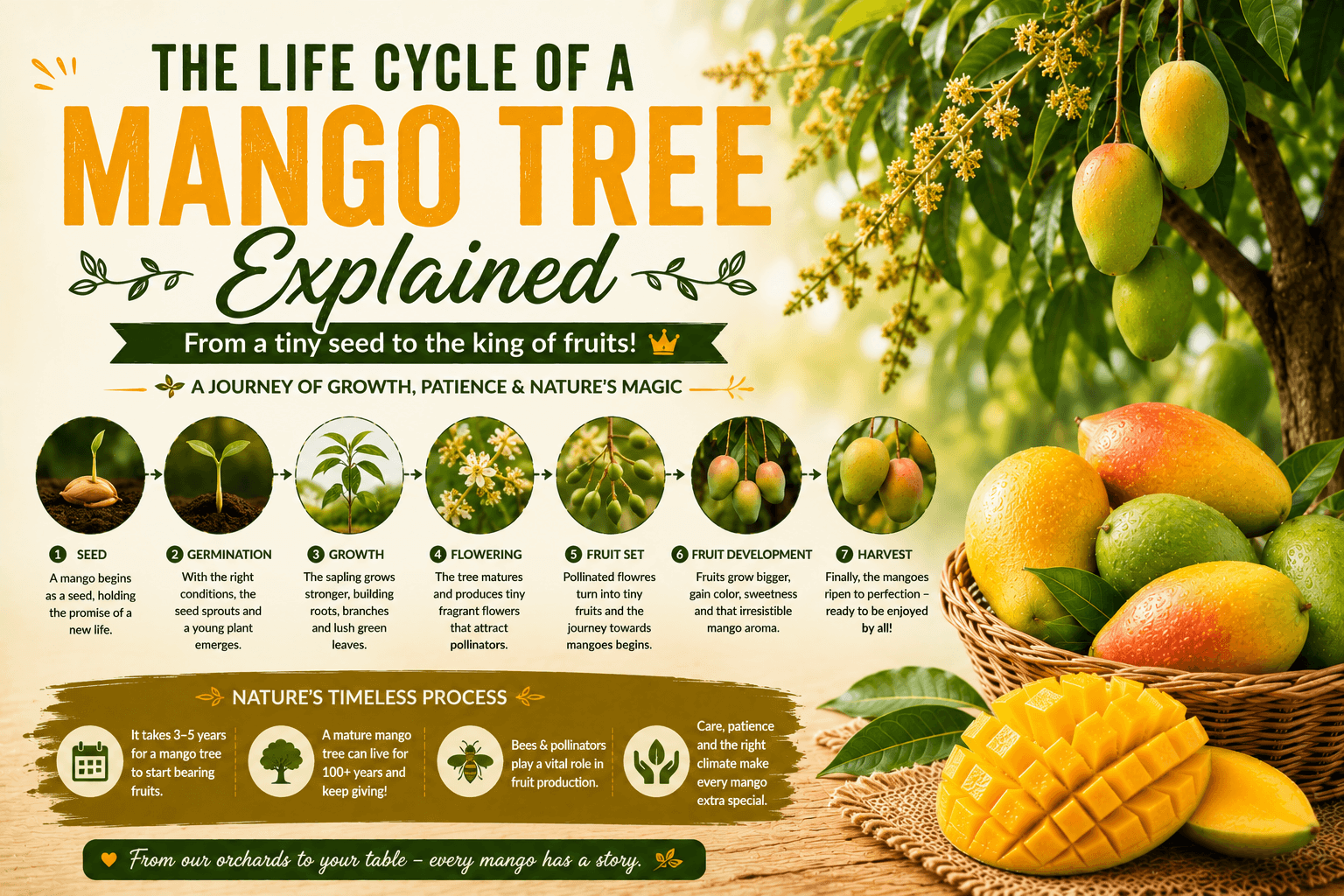
A mango tree is one of nature’s most remarkable creations. From a tiny seed planted in fertile soil to a mature tree producing hundreds of delicious fruits every season, its journey is a fascinating process that unfolds over many years. Every stage of a mango tree’s life involves careful interaction between nature, climate, soil, water, pollinators, and the dedicated efforts of farmers.
Understanding the life cycle of a mango tree helps us appreciate the time, patience, and expertise required to grow premium-quality mangoes. Unlike many crops that mature within months, mango trees take several years before producing their first meaningful harvest. Once established, however, they can continue bearing fruit for decades.
In this guide, we’ll explore every stage of the mango tree’s life cycle, from seed germination to fruit harvesting and beyond.
Stage 1: Seed Germination
Every mango tree begins its life as a seed.
When planted under suitable conditions, the seed absorbs moisture from the soil and begins the germination process. Over time:
- The seed coat softens.
- The first root emerges.
- A young shoot grows upward.
- The seedling begins developing its first leaves.
Warm temperatures, fertile soil, and adequate moisture provide ideal conditions for healthy germination.
Stage 2: Seedling Development
Once the seed has sprouted, the young mango seedling begins establishing itself.
During this stage, the plant focuses on:
- Developing a strong root system.
- Producing new leaves.
- Strengthening the stem.
- Capturing sunlight through photosynthesis.
Healthy seedlings require proper watering, nutrient-rich soil, and protection from pests and harsh weather.
Stage 3: Young Tree Growth
As the seedling matures, it develops into a young mango tree.
This stage may last several years and involves:
- Rapid branch development.
- Expansion of the canopy.
- Root system growth.
- Strong trunk formation.
Farmers carefully manage young trees through:
- Irrigation.
- Mulching.
- Pruning.
- Nutrient management.
- Weed control.
These practices help establish a healthy foundation for future fruit production.
Stage 4: Tree Maturity
After several years, the mango tree reaches maturity.
Depending on the variety, climate, and propagation method, a mango tree may begin producing fruit within 3–8 years if grafted, while seed-grown trees often take considerably longer.
A mature tree is characterized by:
- A broad canopy.
- Strong branches.
- Extensive roots.
- Regular seasonal growth.
At this stage, the tree is capable of producing flowers and fruit each year under favorable conditions.
Stage 5: Flowering
One of the most exciting stages is flowering.
During the flowering season, mango trees produce large clusters known as panicles, each containing hundreds or even thousands of tiny flowers.
Flower production depends on factors such as:
- Temperature.
- Variety.
- Tree health.
- Weather conditions.
- Orchard management.
Only a small percentage of these flowers eventually become mature mangoes.
Stage 6: Pollination
After flowering comes pollination.
Beneficial insects—especially bees—play a crucial role by transferring pollen between flowers.
Successful pollination allows fertilization to occur, which is essential for fruit development.
Pollination success depends on:
- Healthy bee populations.
- Favorable weather.
- Flower quality.
- Overall tree health.
Without effective pollination, many flowers naturally fall without producing fruit.
Stage 7: Fruit Set
Once pollination and fertilization occur, tiny mangoes begin forming.
This stage is called fruit set.
Initially, the developing fruits are very small.
As they grow:
- Cell division increases.
- Fruit tissues develop.
- Seeds begin forming.
- Nutrients move into the fruit.
Natural fruit drop is common during this period as the tree adjusts the number of fruits it can support.
Stage 8: Fruit Development
Over the following weeks, the mangoes increase in size.
During fruit development, the tree transports:
- Water.
- Sugars.
- Minerals.
- Nutrients.
Healthy orchard management during this stage includes:
- Proper irrigation.
- Nutrient application.
- Pest monitoring.
- Disease management.
- Branch support when necessary.
These practices contribute to better fruit quality.
Stage 9: Maturation
As mangoes approach harvest, they reach physiological maturity.
During this stage:
- Growth slows.
- Starch accumulates.
- Seeds mature.
- Flavor compounds develop.
Farmers carefully monitor maturity indicators to determine the ideal harvest time.
Stage 10: Harvesting
Harvesting is one of the most rewarding stages.
Experienced workers carefully handpick mature mangoes to minimize bruising and preserve quality.
Premium mango harvesting involves:
- Selecting mature fruit.
- Gentle handling.
- Proper sorting.
- Careful grading.
- Secure packaging.
Harvest timing significantly influences the final eating quality.
Stage 11: Natural Ripening
After harvest, mangoes continue ripening because they are climacteric fruits.
A naturally occurring plant hormone called ethylene triggers:
- Conversion of starch into sugars.
- Softening of the flesh.
- Aroma development.
- Color changes in many varieties.
Natural ripening produces the rich sweetness and creamy texture that mango lovers enjoy.
Stage 12: Dormancy and Preparation for the Next Season
After harvesting, the tree enters a recovery period.
During this time:
- Energy reserves are replenished.
- New leaves develop.
- Roots continue growing.
- The tree prepares for the next flowering season.
Good post-harvest orchard management ensures healthy future harvests.
Factors That Influence the Mango Tree’s Life Cycle
Several natural and agricultural factors affect each stage of development.
These include:
- Climate.
- Soil fertility.
- Water availability.
- Pollination.
- Sunlight.
- Orchard management.
- Variety.
- Pest and disease control.
When these factors work together, the tree produces healthy, high-quality fruit.
How Long Can a Mango Tree Live?
Mango trees are known for their longevity.
With proper care:
- Many trees produce fruit for several decades.
- Some continue bearing fruit for well over 100 years.
This makes mango cultivation a valuable long-term investment for farming families.
The Importance of Sustainable Orchard Care
Healthy mango trees require continuous care throughout their lives.
Sustainable practices include:
- Responsible irrigation.
- Mulching.
- Soil conservation.
- Biodiversity protection.
- Pollinator-friendly farming.
- Balanced nutrient management.
These methods support healthy orchards and consistent fruit production.
Final Thoughts
The life cycle of a mango tree is a remarkable journey that combines natural processes with skilled farming practices. From seed germination and vigorous young growth to flowering, pollination, fruit development, harvesting, and natural ripening, every stage contributes to the delicious mangoes we enjoy each summer.
Understanding this life cycle helps us appreciate the patience and dedication required to cultivate premium mangoes. Every fruit represents years of growth, careful orchard management, and the harmonious relationship between nature and experienced growers.
Experience the Fruits of Nature’s Remarkable Journey
Enjoy premium Malda Mangoes sourced directly from trusted orchards in West Bengal, where every tree is nurtured with care throughout its life cycle. Our mangoes are handpicked at peak maturity, naturally ripened, carefully graded, thoroughly quality-checked, and securely packed before being delivered fresh across India. Taste the exceptional quality that comes from healthy trees, sustainable farming, and generations of orchard expertise.