

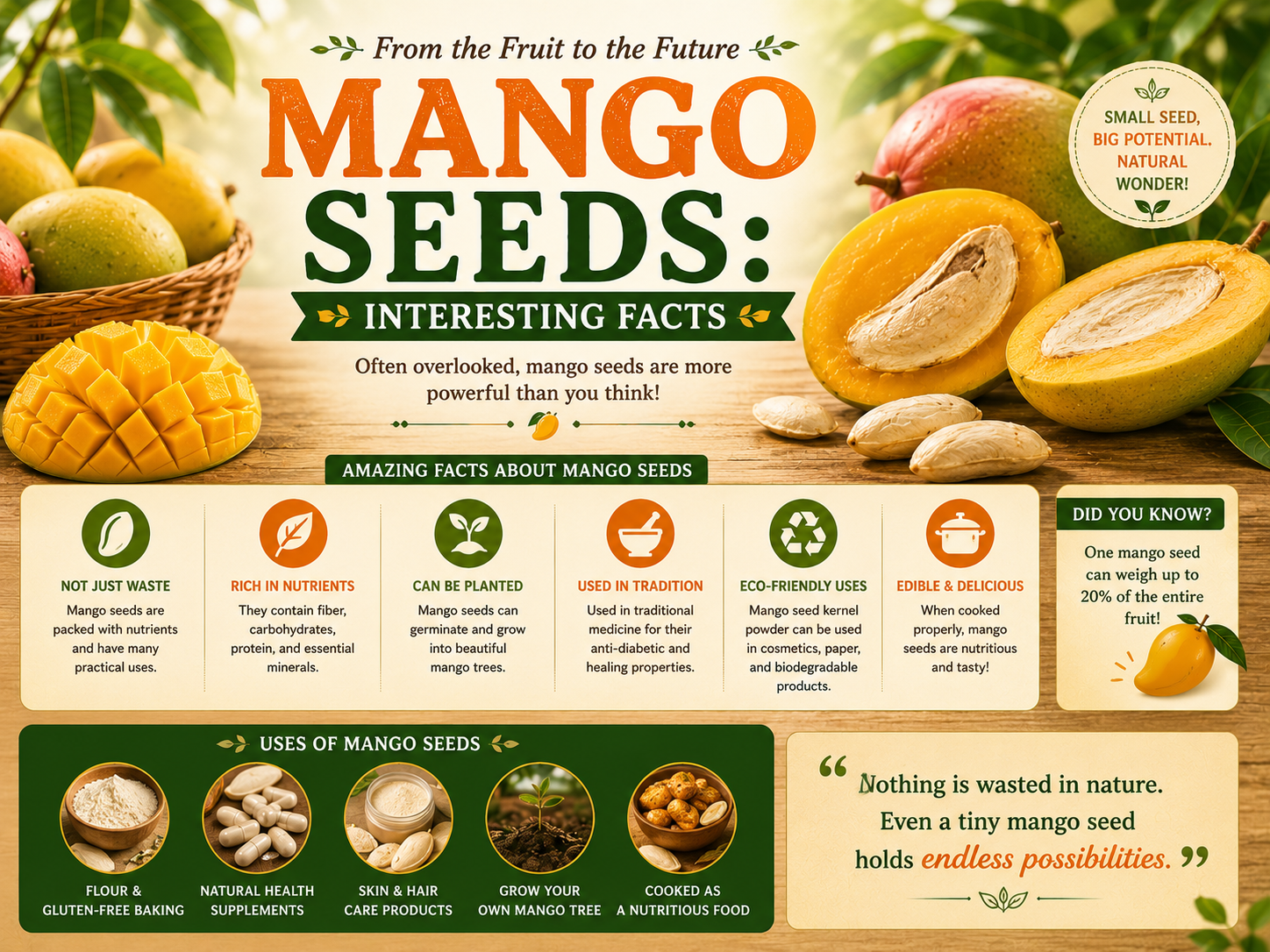
When enjoying a delicious, juicy mango, most people focus on the sweet pulp and often discard the large seed at the center. However, the mango seed is far more fascinating than many realize. It is the beginning of every mango tree and plays a vital role in the fruit’s life cycle, carrying the genetic information needed to grow a new plant.
Beyond its role in reproduction, mango seeds have unique characteristics, interesting biological features, and even practical uses in gardening, agriculture, and research. Whether you’re curious about how mango trees grow or simply want to learn more about the fruit you love, understanding mango seeds offers a deeper appreciation for nature’s remarkable design.
In this article, we’ll explore the structure of mango seeds, how they grow into trees, surprising facts about them, and why they are an essential part of every mango.
What Is a Mango Seed?
The mango seed is the large, flat structure found in the center of the fruit.
It consists of:
- A tough outer shell (also called the stone or pit).
- The seed kernel inside the shell.
- An embryo that can develop into a new mango tree.
- Stored nutrients that support early growth.
The seed protects the young plant until conditions are suitable for germination.
The Mango Seed Is Nature’s Starter Kit
Inside every healthy mango seed is everything needed to begin the life of a new tree.
The seed contains:
- An embryo.
- Stored food reserves.
- Protective layers.
- Genetic information inherited from the parent tree.
These components help the seed survive until it starts growing.
How a Mango Seed Germinates
When a mature seed is placed in suitable conditions, it begins the germination process.
The basic stages include:
- The seed absorbs moisture.
- The embryo becomes active.
- The first root (radicle) emerges.
- A young shoot grows upward.
- Leaves begin to develop.
- The seedling starts producing its own food through photosynthesis.
With proper care, the seedling gradually develops into a healthy mango tree.
Can Every Mango Seed Grow Into a Tree?
Many fresh mango seeds can germinate if they are mature and handled correctly.
Successful germination depends on factors such as:
- Seed freshness.
- Variety.
- Moisture.
- Temperature.
- Air circulation.
- Healthy growing conditions.
Older or dried-out seeds are generally less likely to sprout.
Monoembryonic and Polyembryonic Seeds
Not all mango seeds are the same.
Monoembryonic Seeds
These seeds contain a single embryo and usually produce one seedling.
Many well-known Indian varieties, including Alphonso, fall into this category.
Polyembryonic Seeds
These seeds contain multiple embryos and may produce several seedlings from a single seed.
In many cases, one seedling develops from fertilization, while the others are genetically similar to the parent tree.
Why Commercial Orchards Rarely Rely on Seeds
Although mango seeds can grow into trees, commercial orchards often use grafted saplings instead of growing trees from seed.
Grafted trees are preferred because they:
- Produce fruit more consistently.
- Preserve the desired characteristics of a variety.
- Begin bearing fruit sooner than seed-grown trees.
- Help maintain predictable fruit quality.
Seed-grown trees are still valuable for research, breeding, and home gardening.
Interesting Facts About Mango Seeds
Here are some fascinating facts about mango seeds:
- Every mango contains one large seed enclosed within a hard stone.
- The seed stores nutrients that nourish the young plant during its earliest stages.
- Fresh seeds usually germinate more successfully than seeds that have been allowed to dry out.
- Some mango seeds can produce more than one seedling.
- Seed size varies depending on the mango variety.
- Healthy seeds are essential for successful propagation.
These characteristics make mango seeds unique among many fruit species.
Can You Plant a Mango Seed at Home?
Yes. Many gardening enthusiasts enjoy growing mango seedlings at home.
For the best chance of success:
- Use a fresh, mature mango seed.
- Remove the outer shell carefully if desired.
- Plant the seed in well-draining soil.
- Keep the soil lightly moist but not waterlogged.
- Place the pot in a warm location with bright light.
Growing a mango tree from seed requires patience, as it may take several years to become a mature tree.
The Role of Mango Seeds in Nature
Mango seeds contribute to the natural regeneration of mango trees.
In the wild, seeds may be dispersed through natural processes such as:
- Falling from the tree.
- Movement by animals.
- Water in some environments.
If conditions are favorable, a new seedling can emerge and continue the life cycle.
Are Mango Seeds Useful?
Beyond germination, mango seeds have attracted interest for a variety of applications.
Depending on the context, they have been explored in:
- Agricultural research.
- Plant breeding.
- Gardening.
- Composting after suitable preparation.
- Educational studies about plant development.
Their primary importance, however, remains their role in producing new mango trees.
Why Healthy Orchards Produce Better Seeds
Healthy orchard management supports the production of vigorous fruit and seeds.
Important orchard practices include:
- Proper irrigation.
- Balanced nutrition.
- Pruning.
- Pest and disease management.
- Timely harvesting.
Strong, healthy trees are more likely to produce well-developed fruit and viable seeds.
Mango Seeds and Malda Mangoes
Malda in West Bengal is famous for cultivating premium mango varieties such as:
- Himsagar.
- Fazli.
- Lakshmanbhog.
- Gopalbhog.
- Khirsapati.
These varieties are valued for their rich flavor, smooth pulp, and excellent fruit quality. While commercial orchards generally establish new trees using grafted plants to preserve these characteristics, every fruit still contains a seed that reflects the remarkable biology behind mango cultivation.
Fun Facts About Mango Seeds
Here are a few more interesting facts:
- Mango seeds are among the largest seeds found inside commonly eaten fruits.
- The hard outer shell protects the delicate embryo.
- Seedlings first depend on stored nutrients before producing their own energy through photosynthesis.
- Different mango varieties have seeds of different shapes and sizes.
- Every mature mango tree originally began as a tiny embryo inside a seed.
These facts highlight the incredible journey from seed to fruit-bearing tree.
Final Thoughts
Although they are often overlooked, mango seeds are at the heart of every mango tree’s life cycle. They protect the embryo, provide essential nutrients for early growth, and carry the genetic blueprint for future generations of trees. From germination and propagation to orchard development and scientific research, mango seeds play a far greater role than simply being the part left behind after eating the fruit.
The next time you enjoy a ripe mango, take a moment to appreciate the remarkable seed inside. It represents the beginning of another potential mango tree and reminds us of the fascinating science and natural processes that make this beloved fruit possible.
Experience Premium Malda Mangoes
Enjoy the authentic taste of premium Malda Mangoes sourced directly from trusted orchards in West Bengal. Our Himsagar, Fazli, Lakshmanbhog, Gopalbhog, and Khirsapati mangoes are handpicked at peak maturity, naturally ripened, carefully graded, thoroughly quality-checked, and securely packed before being delivered fresh across India. Every mango reflects generations of orchard expertise, sustainable cultivation, and a commitment to delivering exceptional quality from orchard to your doorstep.