

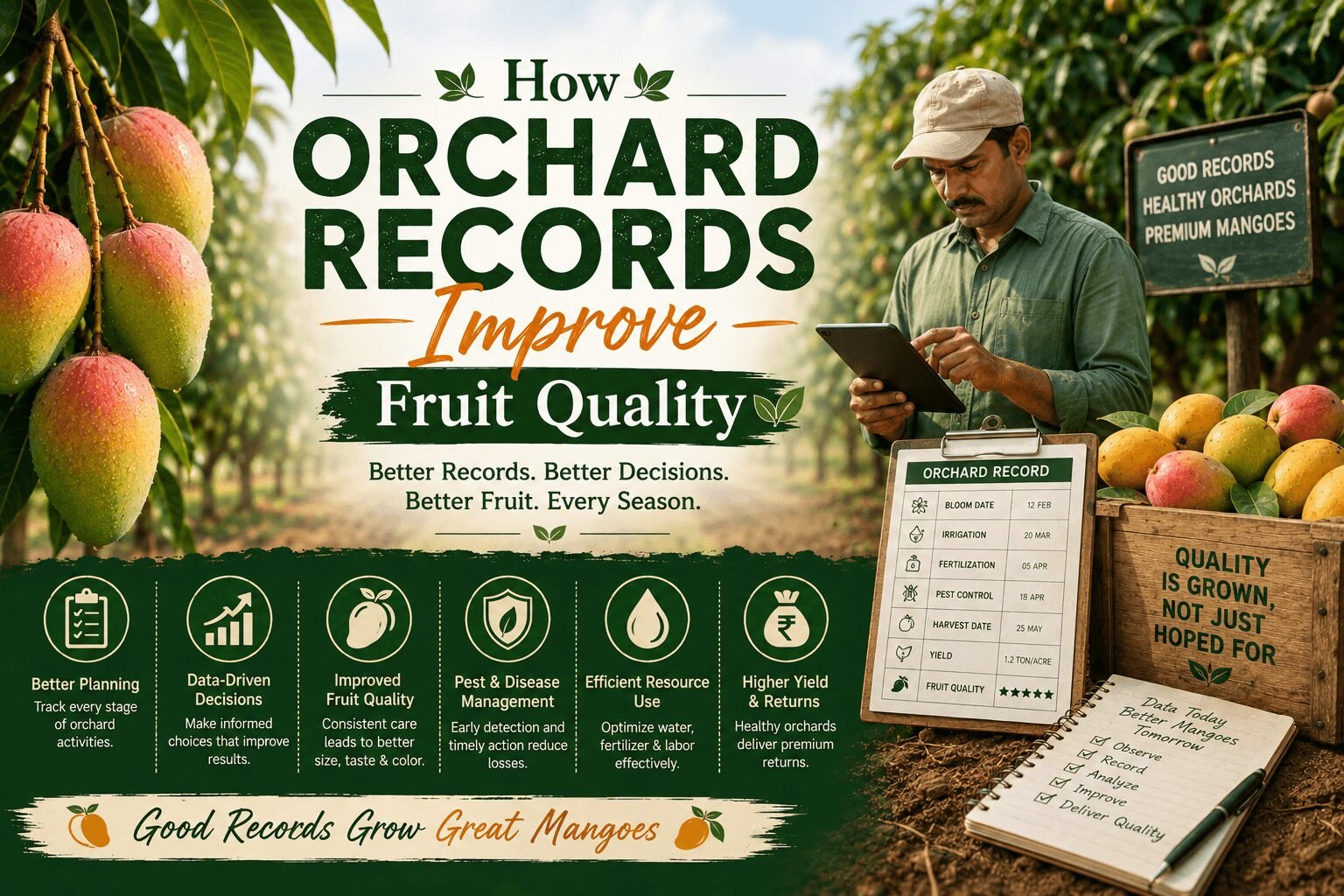
Producing premium-quality mangoes is not just about good weather and fertile soil—it also requires careful planning, observation, and record-keeping throughout the year. Experienced mango growers understand that every season brings valuable lessons, and maintaining detailed orchard records helps them make informed decisions that improve fruit quality year after year.
From monitoring flowering and irrigation schedules to recording weather conditions, harvest dates, and tree performance, orchard records provide insights that help growers better understand their orchards. These records allow farming teams to identify patterns, evaluate the success of different management practices, and continuously improve the quality of the fruit they produce.
In this article, we’ll explore how orchard records improve fruit quality and why record-keeping has become an essential part of modern mango farming.
Why Orchard Records Matter
Every mango season is different.
Keeping accurate records helps growers:
- Understand seasonal changes.
- Monitor orchard performance.
- Improve decision-making.
- Plan future activities.
- Maintain consistency.
- Produce better-quality fruit.
Reliable information allows growers to learn from each harvest and make improvements over time.
Recording Flowering Patterns
Flowering is one of the most important stages in mango production.
Growers often record:
- Flowering dates.
- Flower intensity.
- Tree-to-tree variation.
- Weather during flowering.
- Pollinator activity.
These observations help predict fruit development and improve future orchard planning.
Monitoring Weather Conditions
Weather has a major influence on mango growth.
Orchard records may include:
- Daily temperatures.
- Rainfall.
- Humidity.
- Sunshine hours.
- Wind conditions.
Comparing weather data with fruit quality helps growers understand seasonal trends.
Tracking Irrigation
Efficient water management is essential for healthy mango trees.
Growers commonly record:
- Irrigation dates.
- Water quantity.
- Soil moisture observations.
- Rainfall adjustments.
These records help improve irrigation scheduling while supporting tree health.
Soil Management Records
Healthy soil contributes to premium-quality mangoes.
Important observations include:
- Soil condition.
- Organic matter management.
- Moisture retention.
- Drainage performance.
- Nutrient management activities.
Long-term records help growers maintain productive orchards.
Monitoring Tree Health
Every tree develops differently.
Growers often keep notes on:
- Tree growth.
- Leaf condition.
- Branch development.
- Canopy structure.
- General orchard health.
Regular monitoring allows growers to identify changes early and maintain healthy orchards.
Recording Pollination Activity
Successful pollination plays an important role in fruit development.
Growers may observe:
- Bee activity.
- Flower visitation.
- Fruit set.
- Pollination timing.
Understanding pollination patterns helps improve future orchard management.
Harvest Records
Harvest information is among the most valuable data collected each season.
Records often include:
- Harvest dates.
- Variety harvested.
- Fruit size.
- Fruit quality.
- Yield observations.
These details help growers compare harvests from year to year.
Grading and Quality Assessment
After harvesting, fruit quality is carefully evaluated.
Growers may record:
- Size categories.
- Appearance.
- Ripeness.
- Skin quality.
- Overall grading results.
These records help maintain consistent quality standards.
Learning from Every Season
Because no two mango seasons are identical, every harvest provides valuable information.
Growers review previous records to understand:
- Which management practices worked well.
- How weather influenced production.
- Differences between varieties.
- Opportunities for improvement.
Continuous learning contributes to better fruit quality over time.
Supporting Sustainable Orchard Management
Accurate records also support responsible farming.
They help growers:
- Use water efficiently.
- Plan orchard maintenance.
- Monitor long-term tree health.
- Improve resource management.
- Reduce unnecessary waste.
Well-organized records contribute to sustainable orchard practices.
Combining Traditional Knowledge with Modern Record-Keeping
Many experienced growers combine generations of practical knowledge with modern documentation methods.
Today, orchard records may be maintained using:
- Field notebooks.
- Farm management software.
- Mobile applications.
- Digital spreadsheets.
- Cloud-based record systems.
Technology makes it easier to organize information while preserving valuable farming experience.
Why Malda Growers Value Orchard Records
The mango orchards of Malda, West Bengal, are home to some of India’s finest varieties, including:
- Himsagar.
- Fazli.
- Lakshmanbhog.
- Gopalbhog.
- Khirsapati.
Experienced growers in the region understand that premium fruit quality depends on careful observation throughout the year. By tracking flowering, irrigation, weather conditions, tree health, harvesting, and post-harvest performance, they continually refine orchard management practices. Combined with fertile alluvial soils and generations of farming expertise, these records help produce mangoes known for their naturally sweet flavor, rich aroma, smooth, fibre-light pulp, and exceptional quality.
Practical Benefits of Good Orchard Records
Well-maintained records help growers:
- Improve harvest planning.
- Maintain fruit consistency.
- Identify long-term trends.
- Support better orchard decisions.
- Increase operational efficiency.
- Produce premium-quality mangoes more consistently.
Even small observations can become valuable over time.
Interesting Facts About Orchard Record-Keeping
Here are a few fascinating facts:
- Many successful orchards maintain records throughout the entire year, not just during harvest.
- Weather records help growers compare one season with another.
- Harvest data supports better planning for future crops.
- Modern digital tools make orchard record management easier than ever.
- Combining experience with accurate records helps improve fruit quality over time.
Final Thoughts
Behind every premium mango is not only skilled farming but also careful observation and continuous learning. Orchard records allow growers to understand how weather, flowering, irrigation, soil conditions, and harvesting influence fruit quality. By documenting each season, growers can make informed decisions that improve consistency while adapting to changing environmental conditions.
For consumers, these records may remain invisible, but they play an important role in ensuring that every mango delivered from the orchard meets high standards of freshness, flavor, and quality. They represent the commitment of dedicated growers who work year-round to produce exceptional fruit.
Experience Premium Malda Mangoes
Experience the authentic taste of premium Malda Mangoes sourced directly from trusted orchards in West Bengal. Our Himsagar, Fazli, Lakshmanbhog, Gopalbhog, and Khirsapati mangoes are handpicked at peak maturity, naturally ripened, carefully graded, thoroughly quality-checked, and securely packed before being delivered fresh across India. Through careful orchard record-keeping, expert cultivation, and generations of farming knowledge, our farm-direct mangoes deliver exceptional freshness, rich aroma, naturally sweet flavor, and premium quality in every box.