

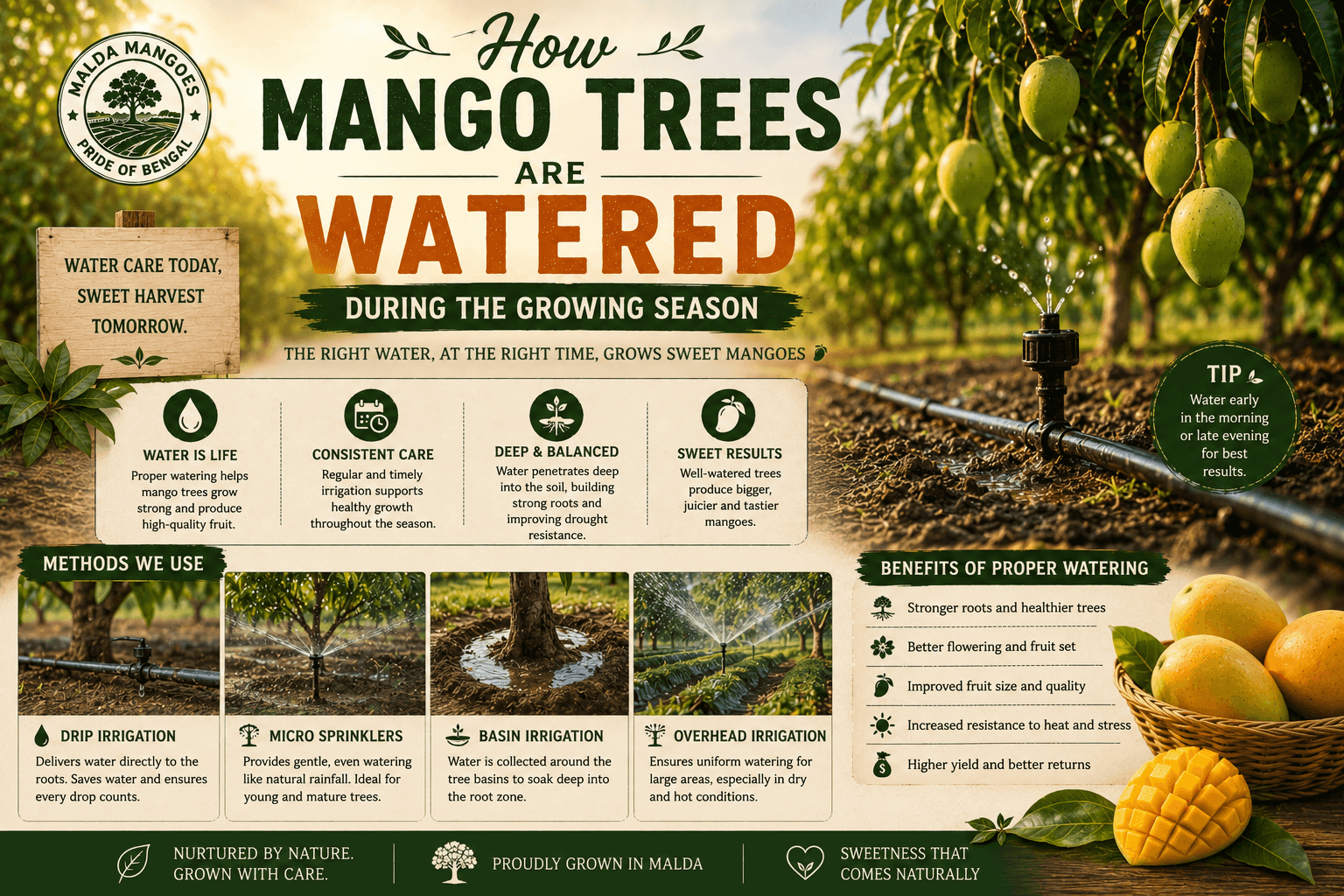
Water is one of the most essential elements for growing healthy mango trees, but successful mango farming isn’t just about watering frequently. It is about providing the right amount of water at the right time. Too little water can stress the trees and reduce fruit quality, while too much water may lead to poor root health and other growing challenges.
In the mango orchards of Malda, experienced farmers carefully monitor soil conditions, weather patterns, and the growth stage of each tree to determine when and how much water is needed. By combining traditional farming knowledge with modern irrigation techniques, they ensure that every tree receives the care it needs to produce sweet, juicy, and premium-quality mangoes.
Let’s take a closer look at how mango trees are watered throughout the growing season and why proper irrigation is one of the most important aspects of successful mango farming.
Why Watering Matters in Mango Farming
Water plays a crucial role in every stage of a mango tree’s growth. From newly planted saplings to mature fruit-bearing trees, proper irrigation supports healthy development and consistent fruit production.
Adequate watering helps:
- Promote strong root growth
- Support healthy leaves and branches
- Encourage flowering
- Aid fruit development
- Improve overall tree health
- Enhance fruit size and quality
Without proper water management, mango trees may struggle to perform at their best.
Understanding the Growing Season
The growing season refers to the period when mango trees are actively developing leaves, flowers, and fruit.
During this time, trees require careful attention because their water needs change depending on:
- Tree age
- Weather conditions
- Soil moisture
- Stage of fruit development
- Rainfall
Experienced farmers regularly assess these factors instead of following a fixed watering routine.
Water Requirements Change with Tree Age
Not all mango trees require the same amount of water.
Young Saplings
Young trees have developing root systems and require more frequent but controlled watering to establish themselves.
Farmers focus on:
- Keeping the soil consistently moist
- Preventing waterlogging
- Encouraging deep root growth
Mature Trees
Established mango trees have extensive root systems that allow them to access moisture from deeper soil layers.
These trees generally require less frequent but deeper watering, especially during dry periods.
Monitoring Soil Moisture
One of the most important irrigation practices is checking soil moisture before watering.
Rather than watering on a fixed schedule, farmers observe:
- Soil condition
- Recent rainfall
- Weather forecasts
- Tree appearance
- Moisture around the root zone
This approach helps prevent both underwatering and overwatering.
Common Irrigation Methods
Different orchards may use different irrigation systems depending on local conditions and available resources.
Some commonly used methods include:
Drip Irrigation
Drip irrigation delivers water slowly and directly to the root zone.
Benefits include:
- Efficient water use
- Reduced evaporation
- Better moisture control
- Lower weed growth
- Improved water conservation
Basin Irrigation
In many traditional orchards, shallow basins are created around the tree to hold water near the roots.
This method allows water to soak gradually into the soil and is still widely used in many mango-growing regions.
Furrow Irrigation
Some orchards use small channels to guide water through rows of trees, ensuring moisture reaches the root zone efficiently.
The choice of irrigation method depends on orchard size, soil type, water availability, and farming practices.
Avoiding Overwatering
Many people assume that more water always leads to healthier trees, but this is not the case.
Excess watering can:
- Reduce oxygen around the roots
- Weaken root development
- Encourage fungal problems
- Affect tree health
Balanced irrigation is always more beneficial than excessive watering.
Conserving Water Through Mulching
Farmers often place organic mulch around the base of mango trees.
Mulching helps:
- Retain soil moisture
- Reduce evaporation
- Keep roots cooler
- Suppress weed growth
- Improve soil quality over time
This simple practice reduces the need for frequent watering while supporting healthier trees.
Irrigation During Fruit Development
As mangoes begin to grow, maintaining consistent soil moisture becomes especially important.
Proper irrigation during this stage supports:
- Healthy fruit growth
- Better fruit size
- Improved texture
- Natural sweetness
- Reduced stress on the tree
Farmers carefully balance water supply to encourage high-quality harvests.
Watering During Different Seasons
The irrigation needs of mango trees vary throughout the year.
- Early Growth: Young trees require regular watering to establish roots.
- Flowering: Balanced irrigation helps support healthy blooms without creating excess moisture.
- Fruit Development: Trees receive carefully managed watering to support growing mangoes.
- After Harvest: Irrigation is adjusted to help trees recover and prepare for the next growing cycle.
Seasonal planning is an important part of successful orchard management.
Sustainable Water Management
Many Malda farmers are adopting sustainable irrigation practices to make the best use of available water.
These include:
- Drip irrigation systems
- Rainwater conservation
- Soil moisture monitoring
- Mulching
- Efficient irrigation scheduling
These practices not only support healthy orchards but also help conserve valuable natural resources.
The Farmer’s Daily Role
Water management requires continuous observation and timely decisions.
Every day, experienced growers may:
- Check soil moisture
- Inspect tree health
- Monitor weather conditions
- Assess fruit development
- Adjust irrigation schedules
- Maintain irrigation systems
Their dedication ensures every tree receives the right care throughout the growing season.
Why Proper Irrigation Produces Better Mangoes
Healthy irrigation practices contribute directly to fruit quality.
Well-watered mango trees are more likely to produce fruits that are:
- Naturally sweet
- Juicy
- Aromatic
- Uniform in size
- Rich in flavor
- Suitable for transportation
Every carefully watered tree plays a role in delivering premium-quality mangoes to customers.
Final Thoughts
Watering mango trees is a carefully managed process that goes far beyond simply adding water to the soil. Successful irrigation requires understanding the tree’s growth stage, monitoring soil moisture, choosing suitable irrigation methods, and adapting to changing weather conditions.
In the orchards of Malda, experienced farmers combine traditional knowledge with modern irrigation practices to maintain healthy trees and produce exceptional mangoes season after season. Their careful attention ensures that every harvest reflects the highest standards of quality and freshness.
Enjoy Farm-Fresh Malda Mangoes
Every premium Malda Mango begins with a healthy, well-watered tree. Our mangoes are sourced directly from trusted orchards where experienced farmers carefully manage irrigation, nurture every tree, and harvest fruit at the perfect stage of maturity. Naturally ripened, handpicked, thoroughly quality-checked, and securely packed, our premium Malda Mangoes are delivered fresh across India so you can enjoy their authentic sweetness and flavor.