

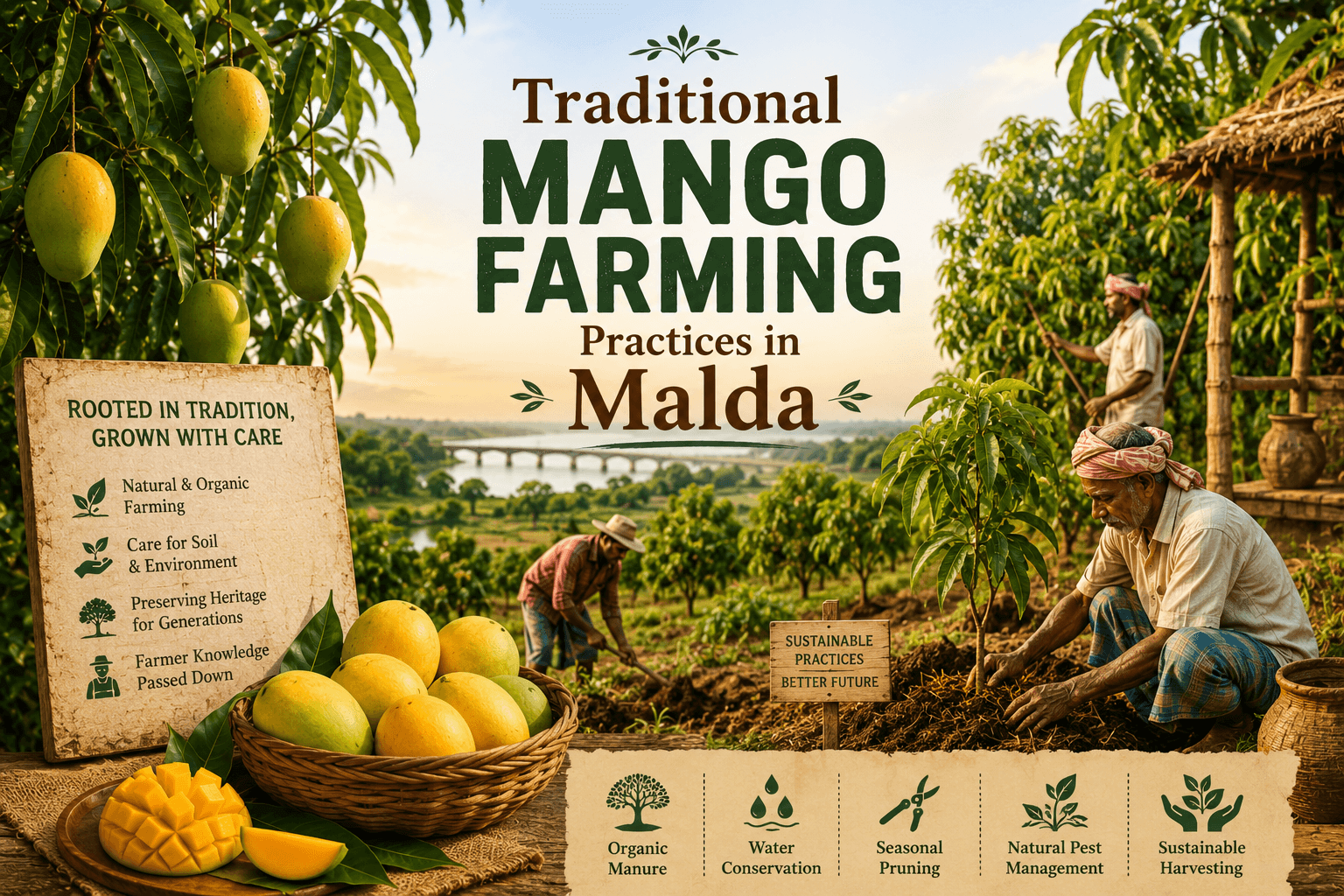
Malda, located in the northern part of West Bengal, has earned a remarkable reputation as one of India’s finest mango-growing regions. While the district is famous for producing delicious varieties such as Himsagar, Fazli, Lakshmanbhog, Gopalbhog, and Khirsapati, the true foundation of this success lies in the traditional farming practices that have been followed for generations.
Long before modern agricultural technologies became widely available, farmers in Malda relied on observation, experience, and a deep understanding of nature to cultivate healthy mango orchards. These time-tested methods continue to play an important role today, often working alongside modern farming techniques to produce high-quality fruit while preserving the region’s rich agricultural heritage.
The Legacy of Mango Farming in Malda
Mango cultivation has been part of Malda’s identity for centuries. Families have passed down orchard management techniques from one generation to the next, ensuring that valuable farming knowledge is preserved.
For many growers, mango farming is more than a profession—it is a tradition built on patience, care, and respect for the land. Every season reflects years of accumulated experience and a commitment to producing mangoes of exceptional quality.
Choosing the Right Land for Orchards
Traditional farmers understood that the success of a mango orchard begins with selecting suitable land.
Malda’s fertile alluvial soil, enriched by the Ganges river system, provides ideal conditions for mango cultivation because it offers:
- Good drainage
- Rich natural nutrients
- Strong root development
- Healthy tree growth
The careful selection of orchard sites has always been one of the key reasons behind the quality of Malda Mangoes.
Growing Healthy Mango Trees
Traditional orchard management focuses on nurturing strong and healthy trees over many years.
Farmers regularly:
- Monitor tree health
- Remove weak or damaged branches
- Encourage balanced growth
- Protect young trees during early development
- Maintain proper spacing between trees
Since mango trees can remain productive for decades, consistent care is essential to ensure healthy harvests year after year.
Natural Orchard Care
For generations, farmers have relied on careful observation to maintain orchard health.
Traditional practices often include:
- Regular inspection of leaves and branches
- Timely removal of diseased plant material
- Maintaining clean orchard surroundings
- Managing water according to seasonal conditions
- Encouraging healthy soil naturally
These methods help create a balanced growing environment while reducing stress on the trees.
Seasonal Irrigation Practices
Water management has always been an important aspect of mango farming.
Experienced farmers understand that mango trees require different amounts of water during various stages of growth.
Traditional irrigation practices focus on:
- Conserving water during dry periods
- Providing adequate moisture before flowering
- Avoiding excessive watering during fruit development
- Adjusting irrigation according to weather conditions
This careful balance supports healthy fruit formation and overall orchard productivity.
Pruning for Better Growth
Pruning has long been an essential part of traditional mango farming.
Farmers remove unnecessary branches to:
- Improve sunlight penetration
- Increase air circulation
- Encourage healthy flowering
- Reduce overcrowding
- Support balanced tree growth
Well-maintained trees are generally easier to manage and produce better-quality fruit.
Understanding Nature’s Seasonal Cycles
One of the greatest strengths of traditional farmers is their close connection with seasonal changes.
Generations of experience have taught growers how to recognize natural signs that indicate:
- Flowering periods
- Fruit development
- Changes in weather
- Harvest readiness
- Seasonal variations
Rather than relying only on technology, farmers combine practical knowledge with careful observation to make informed decisions throughout the growing season.
Hand Harvesting with Care
Harvesting is one of the most delicate stages of mango farming.
Traditional growers carefully handpick mangoes to avoid damaging the fruit or the tree.
Each mango is harvested only after reaching the proper stage of maturity, helping ensure:
- Better flavor
- Longer shelf life
- Reduced bruising
- Improved quality
This careful harvesting process has remained an important tradition in Malda orchards.
Sorting and Grading by Hand
After harvesting, mangoes are traditionally sorted according to:
- Size
- Appearance
- Maturity
- Overall quality
Careful grading ensures that only premium-quality fruit is selected for customers while maintaining consistency across each harvest.
Combining Tradition with Modern Agriculture
Although traditional methods remain central to mango cultivation in Malda, many growers have adopted modern practices to improve efficiency.
These may include:
- Improved irrigation systems
- Scientific orchard monitoring
- Better pest management
- Enhanced packaging
- Faster transportation
Rather than replacing traditional farming, these advancements complement long-standing techniques and help deliver fresher mangoes to customers across India.
Why Traditional Farming Still Matters
Traditional farming practices continue to offer several advantages:
- Deep understanding of local growing conditions
- Careful long-term orchard management
- Skilled hand harvesting
- Strong emphasis on fruit quality
- Preservation of agricultural heritage
- Sustainable cultivation supported by generations of practical knowledge
These practices remain one of the reasons Malda Mangoes are highly respected by mango lovers throughout the country.
The Future of Malda’s Farming Heritage
As consumer demand for premium farm-fresh mangoes continues to grow, preserving traditional farming knowledge becomes increasingly important.
Younger generations of growers are learning from experienced farmers while embracing innovations that improve productivity and quality. This balance between heritage and progress ensures that Malda’s mango-growing legacy will continue for many years.
Final Thoughts
Traditional mango farming practices have played a vital role in building Malda’s reputation as one of India’s premier mango-growing regions. Through careful orchard management, hand harvesting, seasonal expertise, and generations of agricultural knowledge, local farmers have consistently produced mangoes celebrated for their flavor, aroma, and quality.
Every Malda Mango carries the story of dedicated growers who continue to protect and preserve these time-honored traditions. Choosing authentic Malda Mangoes means enjoying fruit that reflects not only nature’s bounty but also the craftsmanship and heritage of generations of farming families.
Experience the Taste of Tradition
Enjoy premium Malda Mangoes grown using generations of orchard expertise and carefully sourced from trusted farms in West Bengal. Our mangoes are naturally ripened, handpicked at the right stage of maturity, thoroughly quality-checked, and securely packed before being delivered fresh across India. Order online today and experience the authentic taste of Malda’s rich farming heritage.